Kaspa adoption signals after Unchained Summit Vietnam were real but narrow: the Kaspa Ecosystem Foundation presented its coordination thesis to a policy, institutional, and Web3 audience on May 29, 2026. That appearance increased exposure and created potential relationships; it did not measure production usage. Contemporaneous KAS prices fell, so no immediate positive price effect can be established.
Key takeaways
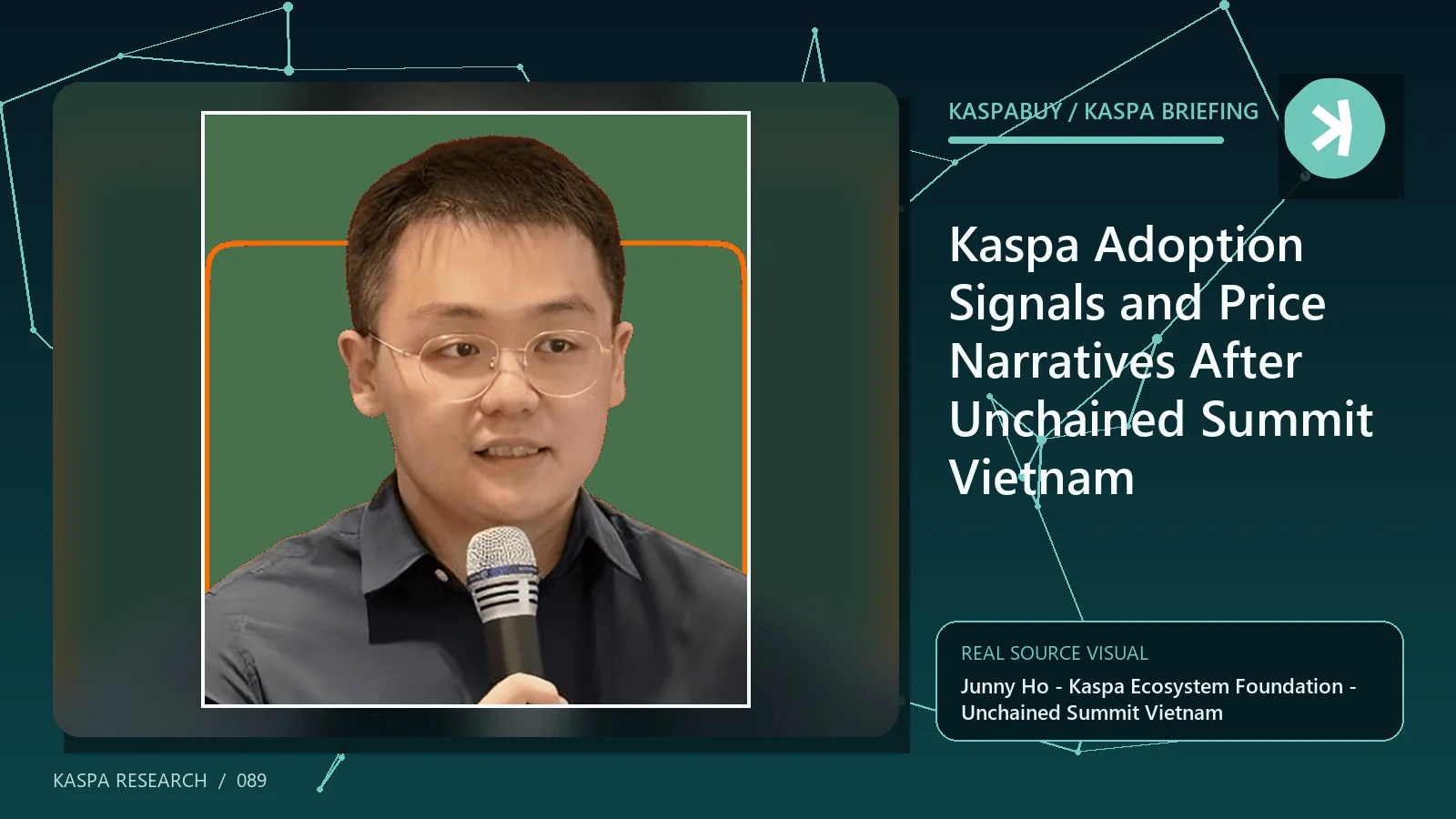
- KEF representative Junny Ho presented “Building Trustless Coordination with Kaspa’s Real-Time Decentralization” at the May 29 summit.
- The event audience included government, regulatory, institutional-investment, and Web3 participants, making the appearance a credible outreach signal.
- A conference presentation is not the same as an integration, signed partnership, capital commitment, or recurring network usage.
- CoinGecko historical data shows KAS closed near $0.03093 on May 29 and $0.02945 on June 4.
- The timing supports neither a bullish event-effect claim nor a causal claim that the summit made the price fall.
What happened at Unchained Summit Vietnam?
The June 4 Kasmedia Weekly Knight report says Junny Ho of the Kaspa Ecosystem Foundation delivered a presentation titled “Building Trustless Coordination with Kaspa’s Real-Time Decentralization” at Unchained Summit Vietnam on May 29. The accompanying KEF post on X supplies the project-side social record.
Kasmedia describes a gathering at the Furama Resort with government officials, regulators, institutional investors, and Web3 leaders discussing adoption, regulation, decentralized finance, tokenization, and artificial intelligence. It names participants associated with Nansen, Tether, MEXC, Ava Labs, B2C2, LPBank Securities, and Vietnam’s State Securities Commission.
The defensible conclusion is that Kaspa’s ideas reached a relevant professional audience. The sources do not provide attendee-level engagement, meeting outcomes, a signed integration, investment, procurement decision, or follow-on deployment attributable to the talk.
Which adoption signals are strong, and which are preliminary?
“Adoption” becomes misleading when every public appearance is placed in the same bucket. A more useful evidence ladder separates exposure from sustained use.
Exposure and access
A confirmed speaking slot, relevant audience, published agenda, and accessible recording are outreach evidence. They show that a project can enter a discussion and articulate a proposition. The Vietnam presentation belongs primarily in this first tier.
Evaluation and commitment
Stronger evidence includes a named pilot, public technical integration, funded grant with deliverables, signed commercial arrangement, testnet deployment, or code contribution from an outside organization. These actions consume resources and create something that can be verified later.
Recurring production use
The strongest adoption evidence measures sustained behavior: active applications, repeat users, transaction patterns attributable to real services, independent node or infrastructure operation, fee activity, retained developers, and audited settlement volumes. Metrics must have clear definitions and should avoid counting bots, self-transfers, bridged duplicates, or incentive-only traffic as organic use.
By this framework, Unchained Summit was a useful top-of-funnel signal. Calling it institutional adoption would skip the evaluation and usage evidence still needed.
What did KAS price data show around the summit?
CoinGecko’s historical Kaspa dataset provides daily USD observations. Values can differ across aggregators and time conventions, so the table uses one consistent source and treats its “close” field as a daily snapshot rather than an exchange-executable price.
| Date | Context | KAS close (USD) | Reported 24-hour volume |
|---|---|---|---|
| May 22, 2026 | One week before the summit | $0.03366762 | $11.68 million |
| May 29, 2026 | Summit presentation date | $0.03093093 | $11.54 million |
| June 4, 2026 | Kasmedia report date | $0.02944846 | $20.54 million |
On this series, KAS was about 8.1% lower on May 29 than on May 22 and another 4.8% lower by June 4. The full May 22-to-June 4 change was approximately -12.5%. Rounding is shown for readability; the percentages are simple changes between CoinGecko daily observations.
This factual window contradicts a simple claim that the conference immediately pushed the asset upward. It does not show that the presentation caused the decline. The price was already moving lower before May 29, and the table does not control for the broader crypto market, liquidity, exchange flows, leverage, macro news, or trader expectations.
Why does timing not establish price causation?
An event and a price move can occur near each other for at least four different reasons: the event caused part of the move; traders anticipated it earlier; both responded to another factor; or the overlap was coincidental. A three-point price window cannot distinguish those explanations.
A credible event study would define the announcement time in advance, select a benchmark market, measure abnormal returns over stated windows, inspect volume and liquidity, test alternative windows, and identify whether the information was new. Even then, causal language should remain proportional to the evidence.
The source article itself mixes verifiable reporting with broad market commentary. Its statements about future rallies are editorial expectations, not data. This analysis does not repeat them as forecasts. Nothing here is investment advice, and no historical move implies a future return.
How did technology milestones affect the narrative?
Kasmedia’s report also described final Toccata ZK hardening on Testnet 10 and continued covenant settlement testing. Those are separately verifiable engineering developments. Our Kaspa Toccata feature guide explains the protocol concepts without treating roadmap progress as user demand.
Community build events provide another intermediate signal. Kaspathon 2026 can reveal prototypes, teams, and technical feedback. A hackathon project is stronger than a vague intention, yet it still requires maintenance, users, and production operation before it becomes durable adoption.
Kaspa’s earlier move to 10 blocks per second is protocol evidence: compatible nodes enforce measurable network behavior. It can make certain applications more practical, but it does not guarantee that businesses will build or users will remain.
What evidence should readers watch next?
For the Vietnam outreach story, look for a public recording, slides, named follow-up programs, technical workshops, pilot announcements, or code and infrastructure contributions from organizations reached through the event. A later claim should link back to a dated artifact rather than rely on a speaker photo alone.
For ecosystem adoption, prefer reproducible dashboards with definitions, application-specific transaction identifiers where privacy permits, audited bridge or settlement reports, public repositories, stable releases, and retention metrics. Separate project-reported figures from independent measurements.
For price narratives, use a consistent data vendor, UTC dates, explicit calculation windows, market benchmarks, and clear uncertainty. A price chart can show what traded; it cannot reveal motivation by itself.
What does this evidence not prove?
The summit record does not prove institutional adoption, government endorsement, regulatory approval, a commercial partnership, or future buying of KAS. The historical prices do not prove that the event harmed the market. The contemporaneous technology updates do not prove application safety, revenue, or recurring demand.
These boundaries are not dismissive. They make the genuine result easier to see: Kaspa earned a relevant stage and communicated a technical coordination thesis to an audience capable of evaluating it. The next step is to document what, if anything, that exposure produced.
Frequently asked questions
Did Unchained Summit Vietnam cause KAS to fall?
There is no evidence for that causal claim. KAS declined in the selected window, including before the presentation, but many unmeasured factors could explain the move.
Was the presentation an adoption milestone?
It was an outreach and access milestone. It becomes a stronger adoption milestone only if it leads to verifiable evaluation, integration, or recurring use.
Why use CoinGecko rather than a single exchange candle?
An aggregator provides a consistent market-wide series for this editorial comparison. It is still a daily snapshot with methodology limits and is not a guaranteed execution price.
Is this a KAS price forecast?
No. The article reports historical observations and evidence limits. It offers no price target, return promise, or investment recommendation.
Source and verification note
Event facts come from the June 4, 2026 Kasmedia report and the linked Kaspa Ecosystem Foundation X post. Historical KAS price, market-cap, and volume observations come from CoinGecko’s Kaspa historical-data page; percentage changes were calculated from the displayed close values. Kasmedia is a secondary ecosystem publication, while the KEF post is a project source. Neither source proves a commercial outcome, and the price series cannot identify causation.