
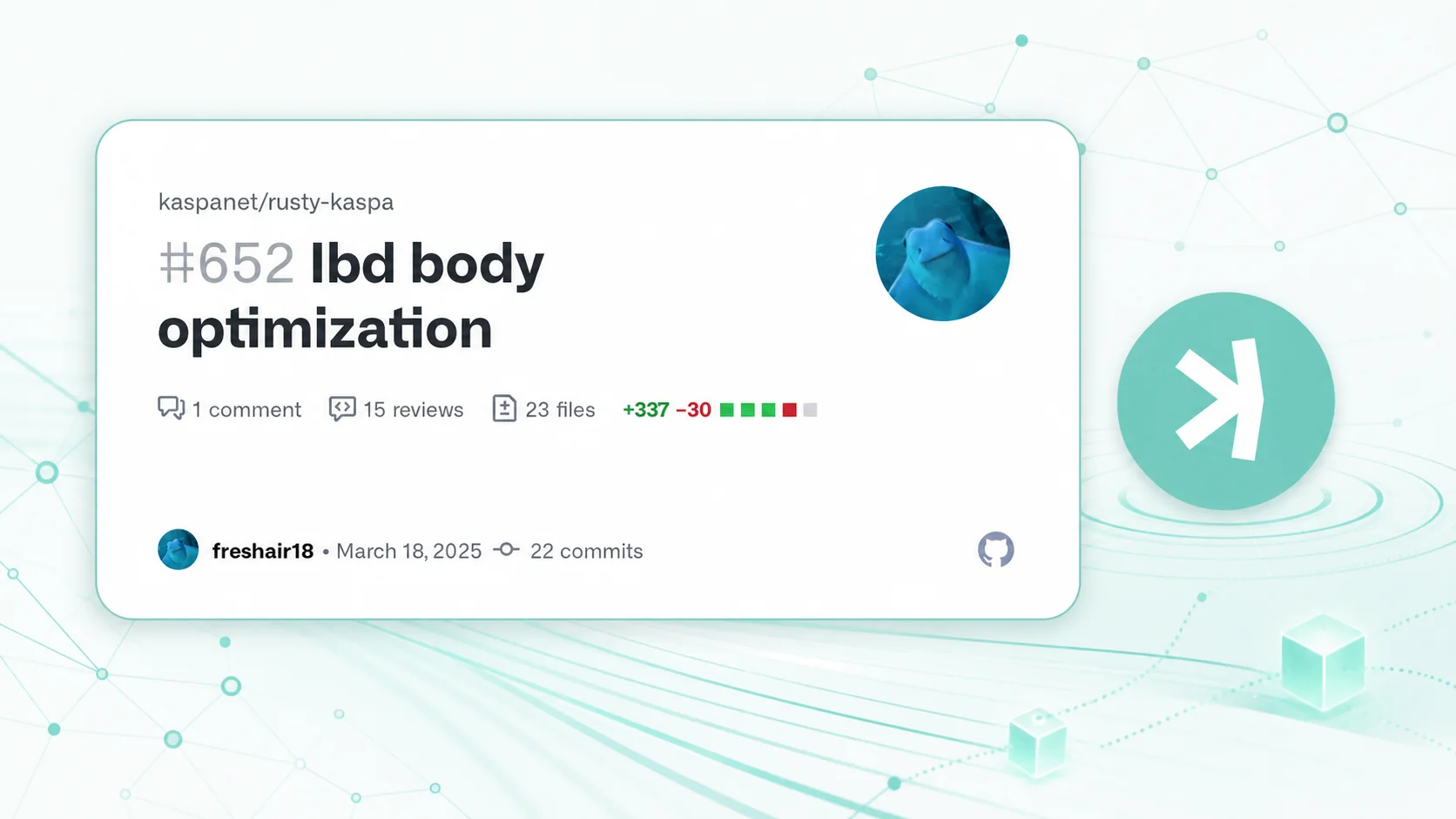
Kaspa Initial Block Download became more efficient in rusty-kaspa when pull request #652 introduced a body-only path for newer peers. After a node has downloaded and checked headers to locate an advanced selected tip, protocol v8 can request transaction bodies without transferring the same headers again. The change reduces redundant work; it does not bypass block validation.
Key takeaways
- Kaspa IBD first uses headers to identify and validate a candidate history, then obtains block transaction bodies.
- Before this change, the later stage downloaded full blocks, including headers the node already held.
- PR #652 added protocol version 8 plus
RequestBlockBodiesandBlockBodypeer messages. - Older protocol flows remain available, so the body-only path depends on negotiated peer capability.
- The pull request supplied no universal seconds-saved benchmark; real results depend on peers, hardware, disk, bandwidth, and chain state.
Why does Kaspa initial synchronization have stages?
A new node needs enough history to independently reach the network’s current state. The header-only phase lets it examine the BlockDAG structure and determine the most advanced selected tip before spending bandwidth on every transaction body. After that history is selected, the node downloads the data needed to process blocks and reconstruct consensus state.
The design issue was documented in rusty-kaspa issue #631. It explains that the later full-block stage formerly included headers that had already arrived during the header phase. Repeating a Bitcoin-derived pattern was simple, but Kaspa headers include multiple parent hashes and higher-level parent hashes rather than a single parent hash. They remain smaller than block bodies, yet are not free to transfer and handle.
What exactly changed in PR #652?
Kaspanet merged rusty-kaspa PR #652 on October 29, 2025. GitHub reports 337 additions, 30 deletions, 23 changed files, and 22 commits. The author summarized the goal as avoiding redundant header downloads and verification after the header-only stage.
The implementation raised the current peer-to-peer protocol constant from 7 to 8 and registered a v8 flow. Two protobuf payloads were added: a request containing block hashes and a response carrying block-body transactions. A new request handler obtains the stored body for a requested hash, while consensus APIs gained a body lookup that rejects unknown blocks or entries without an available body.
The IBD flow also gained a capability switch. Versions 5, 6, and the v7 alias register with body-only IBD disabled; v8 registers with it enabled. That source structure matters because “merged” does not mean every peer immediately uses the new exchange.
How can bodies be downloaded without weakening validation?
The header is not discarded. The receiving node already obtained it in the earlier stage, so the optimized path transfers transactions and associates them with the known block hash and header. Issue #631 describes constructing the block locally and matching and verifying it against the available header.
Avoiding a second transmission is different from trusting a peer. Consensus still has to process the reconstructed block data and reject invalid results. A body-serving peer also cannot make an unknown header acceptable merely by sending transactions. The source API returns BlockNotFound if the requested hash lacks the required stored state.
This distinction is important for operators: the optimization changes the data path, not Kaspa’s consensus rules or the requirement to validate history. It should not be described as “fast sync by trusting a snapshot.”
How much faster should a node synchronize?
The primary source establishes the removed redundancy but does not publish a controlled end-to-end benchmark. Consequently, no honest percentage or fixed number of minutes can be inferred from the diff. Savings should be most visible where repeated header bandwidth and handling are meaningful, but total IBD also includes peer discovery, header acquisition, transaction transfer, validation, database writes, and UTXO-state work.
Measure on the same hardware, software revision, network connection, and data-directory starting point. Record total bytes received, stage timings, CPU, memory, disk throughput, peer protocol versions, disconnects, and final consensus state. A faster run with a different peer set is not a controlled comparison.
Packaging affects a different layer. If you deploy with containers, our Kaspa Docker Images guide explains how the official repository added build recipes without claiming any synchronization speedup.
What does mixed-version compatibility mean?
Protocol negotiation decides which flow two peers can use. The merged code keeps older registrations and only enables body-only IBD in v8. A syncing node connected mainly to older peers may therefore use legacy full-block requests for compatibility, while v8-capable connections can use the new messages.
Operators should upgrade through a tested rusty-kaspa release rather than patching the protocol constant or forcing a peer version. Confirm the release notes, back up relevant configuration, and observe logs for negotiated connections and IBD progress. A custom build from the merge commit is evidence of the code under test, not automatically a supported production release.
Does efficient IBD affect decentralization or price?
Lower synchronization friction can make independent validation more practical, which is a useful network fundamental. It does not prove that every downloaded node will remain online, be publicly reachable, use a distinct operator or hosting provider, or add mining hash power.
It also creates no direct price formula. Our analysis of Kaspa node count and price shows why node activity and market prices require separate measurements. Software engineering evidence should not be converted into a return forecast.
Frequently asked questions
What is an IBD body?
In this context, the body is the block’s transaction list, separated from the header that describes and commits to block data. The v8 messages let a peer request those bodies for known block hashes.
Will every peer use the optimization?
No. The merged source enables the body-only path for protocol v8. Compatibility flows for older versions remain and can use the earlier behavior.
Did PR #652 change Kaspa consensus rules?
The pull request changed peer messages, IBD flows, and data-access APIs. Its stated purpose was removing redundant transfer and verification, not altering block validity rules.
Source and verification note
The central evidence is merged rusty-kaspa PR #652, merged October 29, 2025, together with its originating issue #631. File counts, protocol version, payload names, compatibility behavior, and the staged-IBD rationale were checked against the public diff. Expected efficiency is presented directionally because the source contains no end-to-end benchmark. Consult the current release documentation before operating a node, as protocol support can evolve.