Kaspa Python SDK v1.1.0 was the first production release built from the SDK’s dedicated repository. It kept most public Python APIs familiar while adding GetVirtualChainFromBlockV2, UTXO processor and context bindings, dictionary conversion helpers, generated type stubs, tests, and versioned documentation. Python 3.10 became the minimum, and some positional transaction calls required migration.
Key takeaways
- GitHub marked v1.1.0 as a final, non-prerelease release from the new
kaspanet/kaspa-python-sdkrepository. - The package remained a native Python extension built with PyO3 and Maturin over Rusty Kaspa libraries, not a pure-Python node implementation.
GetVirtualChainFromBlockV2exposed a unified virtual-chain update flow, whileUtxoProcessorandUtxoContextsupported UTXO tracking and maturity-range access.- Python 3.9 support ended, and positional callers of three transaction-generation functions needed to account for reordered parameters.
- The SDK reduces integration work but does not guarantee wallet security, node availability, mainnet feature activation, or any KAS price outcome.
What was released in Kaspa Python SDK v1.1.0?
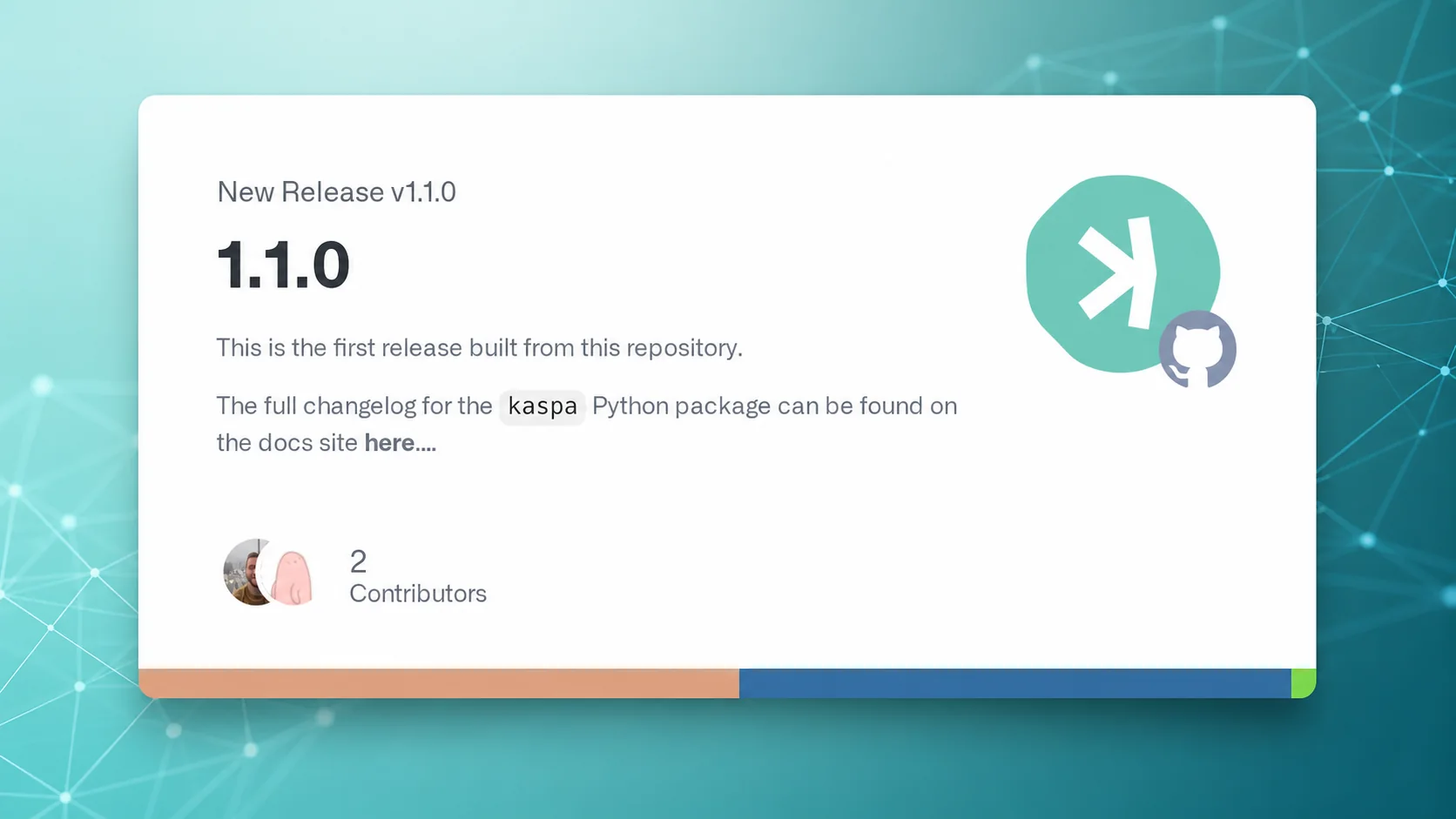
The official v1.1.0 release notes identify it as the first release built from the standalone repository and mark it as a production release rather than a release candidate. The package name remained kaspa, installable from PyPI, and the tagged code depended on Rusty Kaspa commit e97070f.
The repository README groups the SDK into an RPC client, wallet primitives, and a managed-wallet interface. It also states that wallet feature gaps remained relative to the WASM32 SDK. That disclosure prevents “wallet tooling” from being misread as complete parity with every Kaspa client surface.
Why did the dedicated repository matter?
Versions before 1.1.0 were built while the Python SDK lived inside the Rusty Kaspa workspace. The new repository gave Python-specific releases, documentation, examples, tests, typing files, and packaging an independent home. Internals changed substantially, but the notes say exposed Python APIs were largely unchanged.
Separation can make ownership and release discovery clearer. It does not make the underlying Rust dependencies independent: the v1.1.0 tag still pinned Rusty Kaspa components for addresses, keys, consensus types, transaction scripts, wallet functions, and RPC transport.
What did VSPC API v2 offer Python integrators?
The release added GetVirtualChainFromBlockV2, matching the node-side virtual selected parent chain API. The method can return chain changes together with accepted transaction data per added chain block, reducing the need to combine multiple asynchronous data flows.
That is useful for indexers, payment monitors, and wallets that need to follow changes to Kaspa’s selected virtual chain. An API binding does not operate alone: applications still need a compatible node, reconnect logic, idempotent processing, reorganization handling, confirmation policies, and validation of untrusted data.
The language-level work in SilverScript stateful covenants addresses a different layer. Compiler semantics and Python transport APIs can complement each other, but neither proves the other is production-ready.
How did UTXO tracking and data conversion improve?
The SDK exposed UtxoProcessor and UtxoContext for tracking UTXOs and accessing maturity ranges. Transaction-generation functions could also accept a UtxoContext, with the network ID optional for that input form. These additions make it easier to maintain spendable state without recreating every Rust-side abstraction in Python.
Version 1.1.0 also added to_dict() to transactions, inputs, outputs, outpoints, and several UTXO types. Matching from_dict() constructors covered the core transaction structures. Dictionary conversion helps logging, fixtures, APIs, and persistence, but developers must preserve integer precision, binary encodings, network identity, and schema compatibility.
What changed for typing, testing, and documentation?
Most .pyi stubs were generated with pyo3-stub-gen, while RPC request, response, and type definitions remained manually maintained in kaspa_rpc.pyi. The release introduced pytest unit and integration tests plus a versioned MkDocs site. In the documentation model, dev represented the latest main branch and latest the newest production release.
Generated stubs improve editor and static-analysis feedback; they do not enforce runtime correctness. Manually maintained RPC types can also drift, so consumers should pin package versions and run representative integration tests against their node version.
What were the breaking changes?
Python 3.9 was no longer supported; the package metadata required Python 3.10 or later within its declared upper range. In addition, Generator, create_transactions, and estimate_transactions reordered parameters so required values came first. Keyword-argument callers were less exposed, but positional callers needed review.
The notes also corrected ScriptBuilder.add_op and add_ops argument behavior. Before upgrading, teams should pin v1.1.0 in a test environment, run their wallet and RPC suites, inspect deprecation or type errors, and verify transaction bytes before signing or broadcasting.
What did the release not guarantee?
This was a final SDK release, not a hard fork or node activation. It did not audit downstream wallets, secure private-key storage, guarantee public-node uptime, or certify every RPC response. Security-critical applications should follow the repository’s recommendation to consider building from source and should independently review key custody and transaction construction.
The SilverScript debugger guide covers source-level contract inspection; it should not be confused with Python runtime debugging or a wallet audit.
Did v1.1.0 provide a KAS price signal?
No. Release notes document software capabilities and migration risks, not user growth, transaction demand, revenue, or valuation. No defensible price forecast follows from the SDK tag alone.
Frequently asked questions
Is the Kaspa Python SDK pure Python?
No. It is a native extension built with PyO3 and Maturin from bindings to Rust and Rusty Kaspa sources.
What is the minimum Python version for v1.1.0?
Python 3.10. The release explicitly ended Python 3.9 support.
Did existing Python API names all change after the repository move?
No. The release says public Python APIs were largely unchanged, although several transaction function parameter orders changed for positional callers.
Does the SDK replace a Kaspa node?
No. RPC features require connectivity to a compatible node or resolver endpoint, and applications must handle network and state-management failures.
Source and verification note
This article is based on the official Kaspa Python SDK v1.1.0 release, its tagged changelog, and the repository README. They verify final-release status, repository migration, API additions, compatibility changes, documentation, and package architecture. They do not establish downstream security, complete wallet parity, network activation, adoption, or KAS price performance.