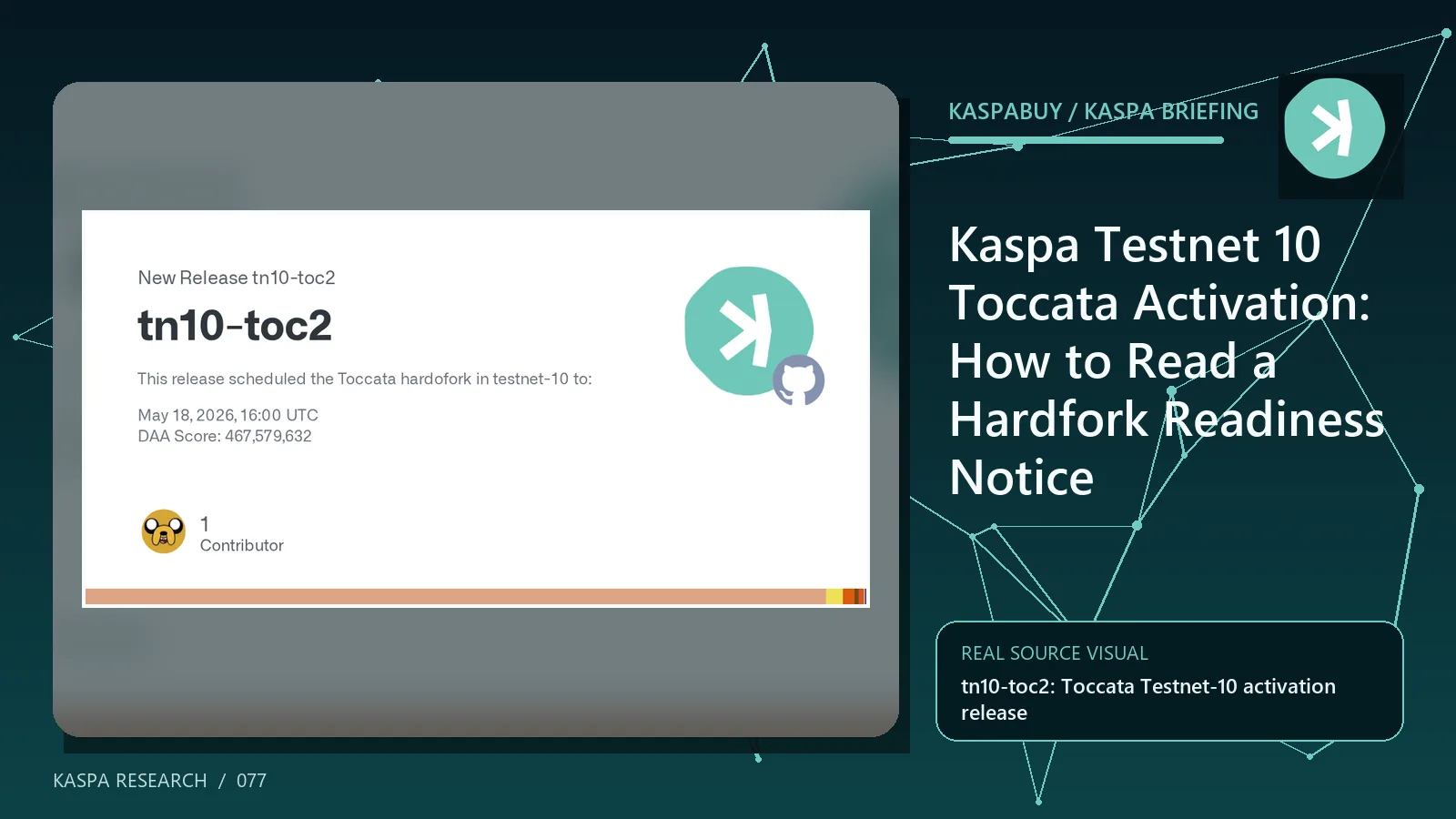
Kaspa’s Testnet 10 Toccata notice signaled that the upgrade stack was ready for a full public hardfork rehearsal, not that mainnet had already changed. The official post scheduled activation for May 18, 2026 at 16:00 UTC and DAA score 467,579,632, while asking testnet node operators and miners to run the designated software.
Key takeaways
- The notice described a Testnet 10 activation, not a mainnet launch.
- A DAA score is the protocol activation trigger; the estimated clock time helps humans coordinate around it.
- Operators needed compatible node software before the activation point to continue following the upgraded testnet rules.
- Public testnet mining helped exercise peer connectivity, block production, and upgrade behavior under broader participation.
- A successful rehearsal reduces uncertainty but does not eliminate the need for mainnet release review, monitoring, and backups.
What did the Testnet 10 notice actually announce?
The Kaspa Project’s public readiness notice said the Toccata hardfork stack was entering its final stage before mainnet activation: a complete hardfork activation on Testnet 10. It supplied two coordination values:
- Estimated time: May 18, 2026 at 16:00 UTC
- Activation DAA score:
467,579,632
The DAA score is the decisive value. Wall-clock estimates can move because block production is probabilistic, while the consensus rule can activate at a specific point in the network’s accumulated work sequence. Operators therefore monitor both: the time for staffing and communication, and the DAA score for protocol behavior.
The announcement also linked the required release and encouraged additional participants to run a testnet node or CPU miner. That invitation matters because a hardfork rehearsal is more informative when software is exercised across different machines, networks, and operator habits.
This public rehearsal followed the earlier Toccata feature freeze and TN12 stabilization stage. The two testnets served different purposes and neither announcement, by itself, changed mainnet consensus.
Why is a hardfork tested on a public testnet?
A protocol upgrade changes which blocks or transactions nodes consider valid. On a testnet, developers and operators can observe the transition without putting mainnet funds at risk. The goal is not merely to see a node start. It is to watch the system cross the activation boundary and remain coherent afterward.
Useful observations include:
- whether upgraded nodes remain connected to the expected peers;
- whether miners produce blocks accepted under the new rules;
- whether RPC clients, explorers, and wallets continue decoding data correctly;
- whether database migrations and restarts behave as documented;
- whether older nodes separate from the upgraded network in the expected way.
These checks are operational as well as technical. Clear instructions, correct binaries, synchronized monitoring, and accessible support channels can determine whether an otherwise correct release is adopted safely.
What did the published commands mean?
The notice showed a minimal node command:
./kaspad --testnet
It also showed a CPU-mining example using the appropriate kaspa-miner binary, the --testnet flag, one mining thread, and a testnet address. The command was an onboarding example, not a complete production configuration. Operators still needed to select the binary for their operating system, verify the download source, protect keys, and understand their network and storage settings.
The --testnet flag is especially important. A testnet address and testnet coins have no mainnet payment role. Mixing environments in documentation or automation can cause confusing failures even when no real funds are at risk. The announcement’s shortened links resolve to the official tn10-toc rusty-kaspa release and Kaspa CPU miner v0.2.7.
How should an operator evaluate a readiness notice?
Start with provenance. Confirm that the announcement links to an official Kaspa repository or release page. Then verify the version, asset name, checksum or signature information where provided, supported operating system, required flags, and activation score.
Next, compare the notice with the repository’s release notes. A social post is useful for reach, but GitHub is the better place to inspect binaries, source changes, known limitations, and follow-up releases. The tn10-toc release page and the v0.2.7 CPU-miner release page are the primary download references behind the commands shown in the notice.
Finally, prepare a rollback and evidence plan. Preserve logs, note peer counts, record the node version, and avoid deleting the previous data directory until the upgrade path is understood. Testnet is where teams should practice these habits before a mainnet deadline makes them urgent.
What did a successful testnet activation prove?
It showed that the selected release could cross the scheduled rule boundary under the observed Testnet 10 conditions. That is meaningful evidence, but it is bounded evidence. It does not prove that every third-party wallet, exchange integration, pool configuration, or custom indexer is compatible. It also does not guarantee that no later maintenance release will be needed.
Kaspa’s earlier move to 10 blocks per second through Crescendo offers useful historical context: major network changes require both consensus code and ecosystem coordination. Toccata’s testnet stage followed the same general discipline while targeting a different set of protocol capabilities.
For one of those capabilities, our KIP-21 implementation overview separates sequencing-commitment development work from testnet activation and eventual mainnet status.
Frequently asked questions
Was Toccata live on Kaspa mainnet on May 18, 2026?
No. The cited announcement was specifically for a Testnet 10 hardfork activation. Mainnet required its own release, activation point, and ecosystem upgrade process.
Why publish both a UTC time and a DAA score?
The time helps people plan, while the DAA score defines the protocol trigger. Because block timing can vary, the estimated time is not a substitute for monitoring the score.
Could anyone join the Testnet 10 rehearsal?
The official post encouraged new participants to run a testnet node and mine with the linked release. Participants still needed to follow software-verification and operational-security practices.
Source and verification note
The primary source is the Kaspa Project Testnet 10 activation post. Its shortened download links were resolved and cross-checked against the official tn10-toc and cpuminer v0.2.7 release pages. This article describes protocol readiness and does not make a price or investment claim.