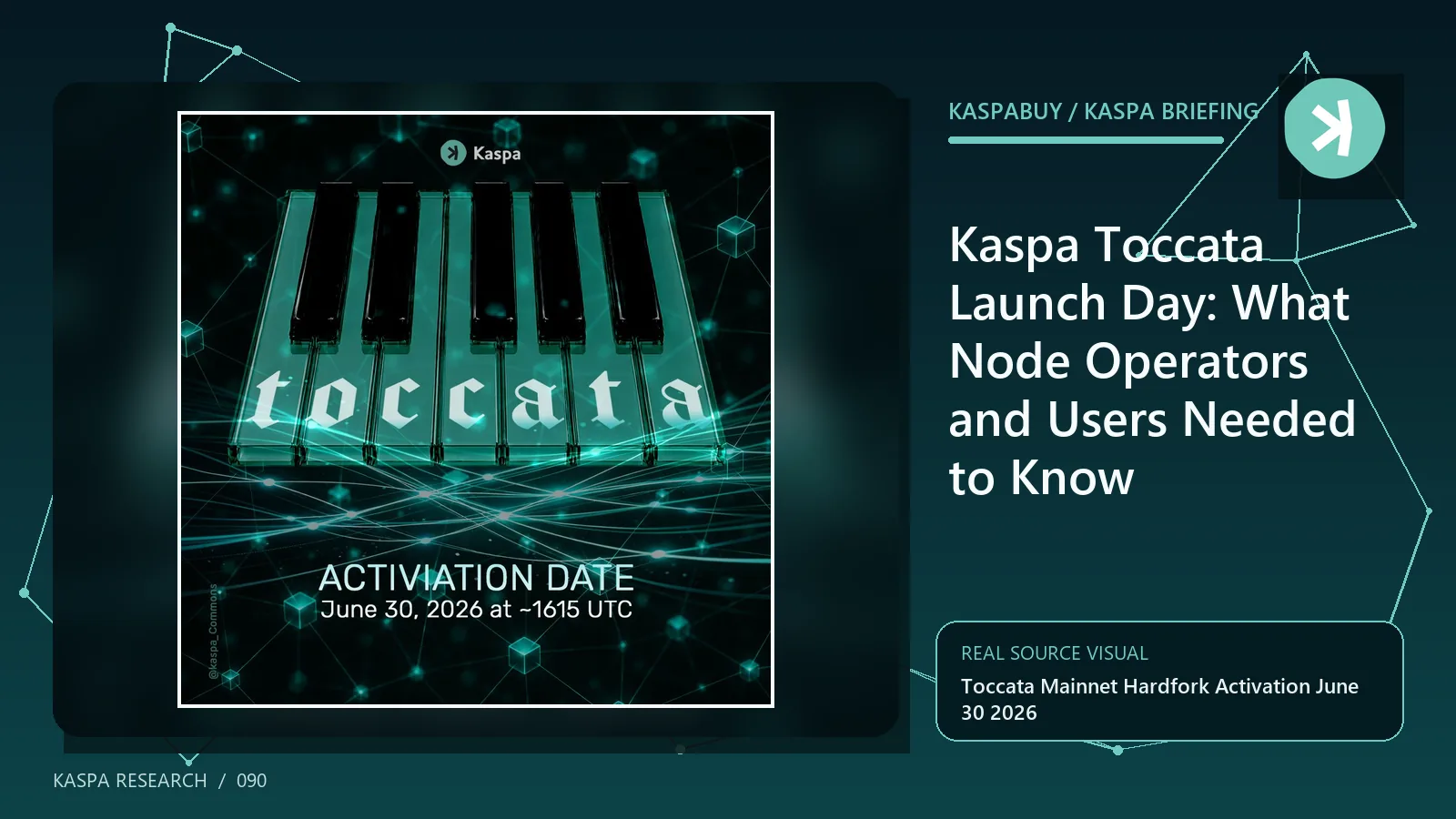
Kaspa Toccata launch day required action from infrastructure operators, not ordinary holders. The official v2.0.0 release scheduled enforcement at DAA score 474,165,565, approximately June 30, 2026 at 16:15 UTC, and warned that updated nodes would reject old P2P peers 24 hours earlier. Nodes, pools, exchanges, wallets, and indexers needed compatible software and tested data paths.
Key takeaways
- The June 5 mainnet package was Rusty Kaspa v2.0.0; the hardfork rules were scheduled to activate later at DAA score
474,165,565. - Updated nodes would disconnect peers on the old P2P protocol 24 hours before activation.
- Node database migration was one-way, so rollback planning required a backup strategy or a resync.
- Integrators needed to handle transaction version 1, compute budgets, covenant fields, covenant IDs, and the
storageMassnaming transition. - People who only held or sent KAS through maintained wallet software did not need to run a node, but they did need a compatible wallet or service.
What did Kaspa announce on Toccata release day?
The official Kaspa Project LinkedIn notice said the Toccata release was available, named the approximate June 30 activation time, and asked nodes, pools, exchanges, and other ecosystem participants to upgrade. It also warned that updated nodes would begin disconnecting non-updated nodes 24 hours before the fork.
The authoritative software artifact was the Rusty Kaspa v2.0.0 release, published June 5. Its notes identify KIPs 16, 17, 20, and 21 as the hardfork scope and set DAA score 474,165,565 as the consensus trigger. The date and time were an estimate for operator planning; the DAA score determined enforcement.
That difference prevents a common launch-day error. Installing the binary did not immediately activate covenant or sequencing rules. It prepared a node to continue following Kaspa when the network reached the configured score.
Why did the P2P cutoff come first?
Toccata moved compatible nodes to P2P protocol version 10. The release notes scheduled the peer-compatibility cutoff 24 hours before activation. This created an operational buffer: upgraded nodes could form a compatible network before they began validating Toccata blocks.
An old node could continue running locally, but it would lose compatible peers and would not understand the post-fork consensus rules. For a miner, exchange, or pool, that was more than an inconvenience. Mining through an outdated node risked constructing or accepting data under obsolete rules, while an exchange risked reporting a view that no longer matched the upgraded network.
The Toccata merge overview explains the code-integration stage. Release day added the stable package and operator coordination that a development-branch merge could not provide.
What did node operators need to do?
Operators needed to obtain binaries from the official release or build the tagged/stable source, verify their existing flags, and let the node synchronize fully. The versioned Toccata node guide recommended testing production workflows against Testnet 10 before activation.
The guide also warned that the database upgrade was one-way. An operator who migrated an existing data directory could not simply launch an older node against that upgraded database. Returning to an earlier version could require deleting the database and synchronizing again. Pools and exchanges therefore needed maintenance windows, disk headroom, and rollback plans based on resync rather than assumed schema compatibility.
The launch guide’s minimum hardware profile was eight CPU cores, 16 GB RAM, a 640 GB SSD, and approximately 80 Mbit/s of network bandwidth. Its preferred profile for higher-performance public or pool infrastructure was 12 to 16 cores, 32 GB RAM, a 1 TB SSD, and additional bandwidth. These were project recommendations, not guarantees for every workload, host, database history, or traffic pattern.
What did pools, miners, and exchanges need to test?
Toccata changed more than the node version string. Infrastructure that parses, reconstructs, signs, or indexes transactions needed to preserve new fields end to end.
Pools and custom mining stacks
Pools had to upgrade all nodes and ensure their template-to-job-to-solved-block path preserved block-header version, transaction version 1, storage_mass, input computeBudget, and output covenant data. A custom job format that silently dropped a field could reconstruct an invalid block after activation. The official guide recommended a full GetBlockTemplate to work distribution to SubmitBlock rehearsal on Testnet 10.
Exchanges and custodians
Exchanges needed compatible SDK or regenerated protobuf bindings, plus deposit, withdrawal, indexing, balance, and fee-estimation tests. Storage schemas had to accept covenant bindings and UTXO covenant IDs. A synced node alone did not prove that an exchange’s downstream ledger understood the new transaction representation.
Wallet and payment developers
Wallets using the RPC fee estimator could follow node policy dynamically. Software with a fixed fee assumption needed the updated standard minimum: 100 sompi * max(compute grams, 2 * transaction bytes). The guide is explicit that this is node relay and mempool policy, not a consensus minimum; a zero-fee transaction may be consensus-valid while upgraded nodes decline to relay it.
This distinction is especially important for merchant payments. A transaction can be structurally valid yet fail to propagate because its fee policy is outdated. Integrators should report that condition accurately instead of telling a customer that the network rejected the ownership signature.
Which RPC and data-model changes mattered?
The transaction field previously exposed as mass became storage_mass in Rust/protobuf and storageMass in JSON/JavaScript. JSON retained a compatibility alias, but conflicting values were rejected. New code was expected to use the explicit storage name.
Protobuf transaction inputs gained computeBudget, outputs gained an optional covenant binding, and UTXO entries could carry a covenant_id. Indexers that persisted only value and script public key would lose relevant post-Toccata state. Developers also needed version-1 transaction support rather than assuming every transaction had the legacy layout.
For the exact activation trigger, see Kaspa Toccata mainnet activation and DAA score 474,165,565. That guide separates a consensus counter from the approximate calendar forecast.
What did ordinary Kaspa users need to do?
A person using a maintained wallet, exchange, or merchant service did not need to install kaspad. They needed to confirm that their provider had announced Toccata compatibility and avoid sending time-sensitive funds through an obviously outdated service near the upgrade window.
Self-custody users should follow the wallet’s official release channel, protect their seed phrase, and reject anyone asking for it in the name of a hardfork. Consensus upgrades do not require moving coins to a new address merely because the node protocol changes.
For community members marking the milestone, the Kaspa IYKYK flat-brim cap is a cultural item, not technical evidence or an investment. Merch can start a conversation about the upgrade, but it does not confer network access, token ownership, or protocol rights.
What did launch day not prove?
The release did not prove that all nodes or services had upgraded, that every covenant application was secure, or that a production ZK bridge existed. It did not guarantee the approximate activation time to the minute, because the score threshold controlled the fork.
It also supplied no KAS price target. A protocol release can improve technical capability while market prices respond to unrelated liquidity, macroeconomic, and risk factors. Operator readiness and asset valuation require different evidence.
Frequently asked questions
Did Toccata activate when v2.0.0 was downloaded?
No. The binary contained the rules, but mainnet activation was scheduled for DAA score 474,165,565.
Did every KAS holder need to run v2.0.0?
No. Node and infrastructure operators needed compatible software. Ordinary users needed a maintained wallet or service.
Could an operator downgrade the migrated database?
The launch guide said the database migration was one-way. Returning to older software could require a fresh synchronization.
Was the new minimum fee a consensus rule?
No. It was standard transaction-submission and relay policy. Consensus validity and a node’s willingness to relay a transaction are separate questions.
Source and verification note
The public announcement is the Kaspa Project LinkedIn post. Activation, protocol-version, KIP-scope, and release facts were checked against the official v2.0.0 GitHub release and its versioned Toccata setup guide. This article records the June 5 launch-day instructions; later maintenance versions should be preferred where the maintained guide recommends them. These sources establish release guidance, not universal upgrade completion, application security, adoption, or price impact.