Kaspa Toccata mainnet activation was defined by DAA score 474,165,565, not by a wall-clock timestamp. Rusty Kaspa PR #1044 set that consensus parameter and estimated the threshold for June 30, 2026 at 16:15 UTC. Compatible nodes switched rules when their consensus view crossed the score; the calendar time was operational guidance.
Key takeaways
- Rusty Kaspa PR #1044 set mainnet Toccata activation to DAA score
474,165,565. - The pull request described the threshold as almost exactly 360 million blocks after Crescendo.
- DAA score is a DAG-aware consensus progress measure, not a simple sequential block height.
- June 30 at approximately 16:15 UTC was an estimate; the configured score was the authoritative trigger.
- The final
565references Bach’s Toccata and Fugue in D Minor, BWV 565, an easter egg that does not change the consensus meaning.
What changed in Rusty Kaspa PR #1044?
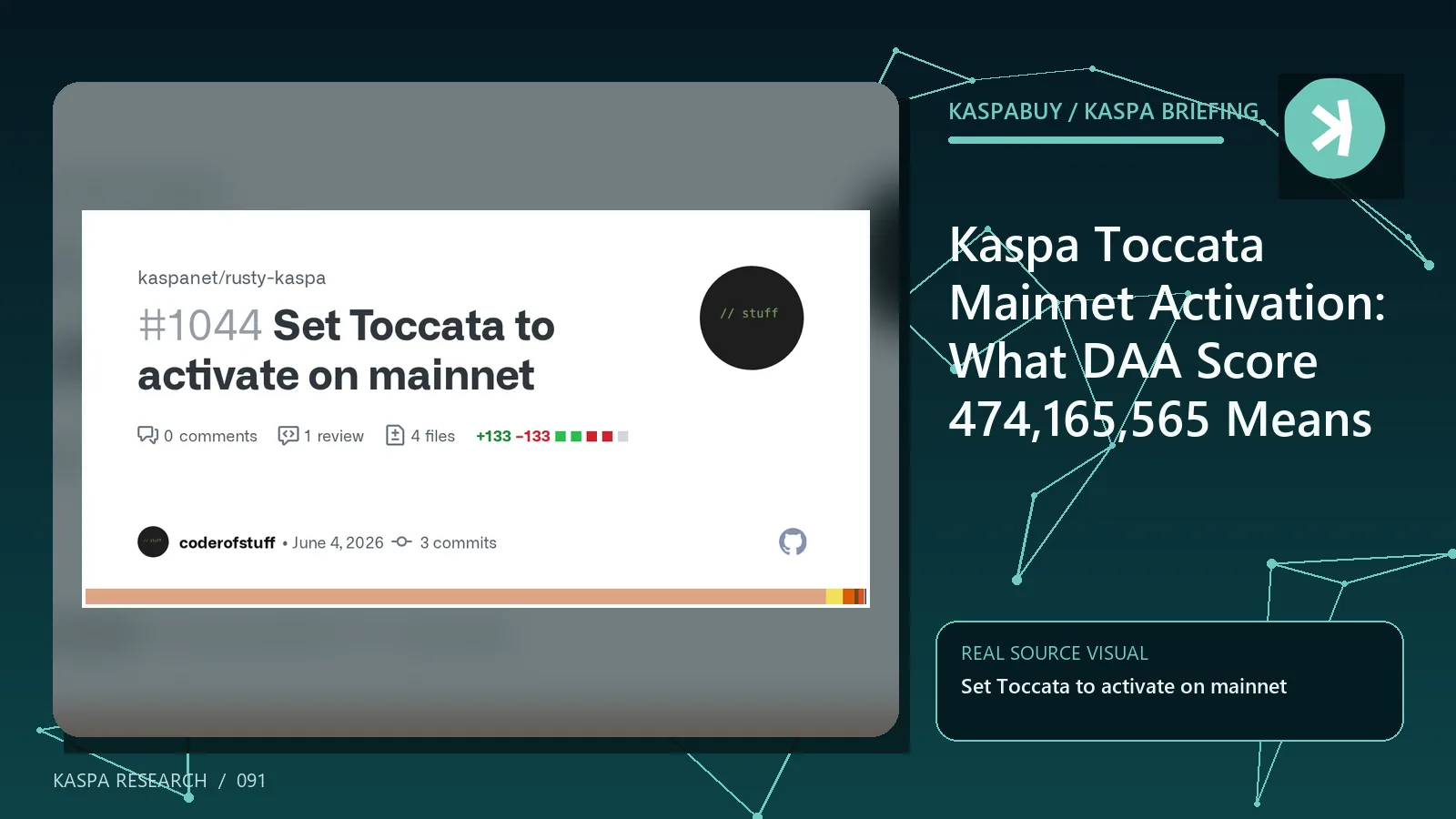
The official activation pull request merged three commits into master on June 5, 2026. Its central code change set the mainnet toccata_activation parameter to 474_165_565. The same review updated the workspace to v2.0.0 and made small transaction/version adjustments associated with the release line.
GitHub reports four changed files, with 133 additions and 133 deletions. Most of that apparent churn came from workspace version updates in Cargo.toml and Cargo.lock; the consensus parameter itself was a focused change in the network configuration. This is why raw line counts should not be used as a proxy for the importance of a consensus edit.
The PR description supplied two human-readable interpretations: almost 360 million blocks after Crescendo and roughly June 30 at 16:15 UTC. Only the DAA score was encoded as the activation condition.
What is a Kaspa DAA score?
Kaspa is a blockDAG, so multiple blocks can be created in parallel and later merged into a common consensus view. There is no single linear height that captures all rewarded DAG progress in the same way a traditional chain height does.
Kaspa’s integration guide summarizes DAA score as the total number of merged blocks from the relevant block’s point of view. The Kaspa Wiki gives a more operational definition: DAA score combines blue score with successfully merged and rewarded red blocks. It is used by the difficulty and emission machinery and can advance by more than one as parallel blocks are merged.
That makes DAA score suitable for a deterministic fork threshold. Every compatible validator evaluates the parameter against its consensus context rather than consulting a centralized clock or waiting for a human announcement.
Why was the calendar time only approximate?
The project estimated when score 474,165,565 would arrive from observed network progress. Real block production varies with hashrate, propagation, parallelism, and DAG merges. A score can therefore arrive earlier or later than a projection, even when average block cadence is stable.
Wall clocks also differ, and network messages can reach peers at different moments. A timestamp-based social agreement would create avoidable ambiguity. The score gives software an objective boundary derived from the DAG data it already validates.
For operations, the estimate was still valuable. Exchanges could schedule change freezes, pools could rehearse template handling, and node operators could monitor synchronization. The safe rule was to finish before the window, not to wait for 16:14 UTC and hope the forecast was exact.
What happened before and after the threshold?
Before activation, upgraded nodes continued validating mainnet under the pre-Toccata rule set, while carrying dormant code for the new rules. The release also coordinated a P2P protocol transition: updated nodes were scheduled to disconnect old-protocol peers 24 hours before activation so the compatible peer network could form in advance.
At and after the threshold, upgraded nodes enforced Toccata transaction versions, script behavior, covenant data, sequencing commitments, proof-verification behavior, and other activated rules. An outdated node could disagree with valid post-fork data or fail to maintain compatible peers.
The Kaspa Toccata launch-day guide lists the separate work for miners, exchanges, wallets, pools, and indexers. Reaching the DAA score did not repair an integration that dropped new fields when reconstructing a transaction or block.
Why mention the 360-million-block interval?
PR #1044 says the threshold was almost exactly 360 million blocks after Crescendo. That creates a memorable relationship between Kaspa’s 10-BPS era and its next protocol upgrade. It is descriptive context, not the activation algorithm.
Dividing 360 million by a nominal 10 blocks per second gives 36 million seconds, or roughly 417 days. That approximation is close to the period from Crescendo’s May 2025 activation to the late-June 2026 Toccata window. It should not be used to reconstruct the exact consensus score because DAG progress and DAA accounting are more specific than a wall-clock multiplication.
What is the significance of the final 565?
The PR author states that the additional 565 references Johann Sebastian Bach’s Toccata and Fugue in D Minor, BWV 565. It is a project easter egg embedded in the chosen threshold.
The reference has no separate protocol effect. Nodes compare an integer score with a configured integer. A memorable suffix can help humans recognize the value, but it does not add a grace period, musical timing rule, or secondary activation condition.
How could operators verify readiness?
An operator needed three different checks:
- Software: run the official Toccata-compatible release and verify its reported version.
- Synchronization: confirm that the node’s virtual DAA score was current and that IBD had completed.
- Integration: exercise RPC, transaction, indexing, wallet, or mining flows using post-Toccata fields on Testnet 10.
Monitoring an explorer was useful for situational awareness, but each node enforced consensus from locally validated data. An exchange should not substitute a public website screenshot for its own node health and reconciliation controls.
The next maintenance milestone, Rusty Kaspa v2.0.1, added RPC and synchronization refinements while remaining suitable for the Toccata upgrade path.
What does the activation score not prove?
The score proves a deterministic boundary exists in compatible software. It does not prove how many independently operated nodes had upgraded, that every service was compatible, or that every post-fork application was secure. Those claims need telemetry, operator disclosures, reproducible transactions, audits, and longer observation.
Activation also does not prove adoption or economic impact. A network capability can become available before applications gain users. No price prediction follows from an integer in the consensus configuration.
Frequently asked questions
Is DAA score the same as block height?
No. It is a DAG-aware measure of merged and rewarded progress, while a simple block height assumes one linear sequence.
Did Toccata activate exactly at 16:15 UTC?
The time was an estimate. DAA score 474,165,565 was the consensus trigger.
Could an updated node activate early because its computer clock was wrong?
Not merely because of its local wall clock. Activation was evaluated from the validated DAA-score context.
Did the number 565 change any rule besides the threshold?
No. It was part of the chosen score and a cultural reference to BWV 565; it did not add another mechanism.
Source and verification note
The primary source is merged kaspanet/rusty-kaspa PR #1044, including its public description, three commits, four-file diff, and configuration change. The DAA explanation was cross-checked against Kaspa’s BlockDAG integration guide and the project’s technical knowledge base. The official v2.0.0 release confirms the same score and approximate time. These records establish the configured trigger and release guidance, not universal upgrade completion, application security, adoption, or price effects.