The Kaspa Toccata Node Upgrade Guide gives operators one overriding instruction: run rusty-kaspa v2.0.1 or newer before DAA score 474,165,565. The final checklist also changes what wallets, exchanges, pools and indexers must test, especially version-1 transactions, covenant fields, compute budgets, storage-mass naming and minimum relay-fee calculations.
Key takeaways
- Toccata was scheduled for mainnet activation at DAA score
474,165,565, approximately June 30, 2026 at 16:15 UTC. - The maintained Toccata setup guide directs operators to rusty-kaspa v2.0.1 or newer.
- A non-upgraded node can follow incompatible rules; an exchange can record wrong balances, and a miner can submit invalid blocks.
- Fixed-fee software must account for the
100 sompi * max(compute grams, 2 * transaction bytes)minimum standard fee policy. - Pools must preserve new template fields from
GetBlockTemplatethrough solved-block reconstruction andSubmitBlock. - Testing the whole business flow on Testnet-10 matters more than checking that a daemon merely starts.
What changed in the final Toccata guide?
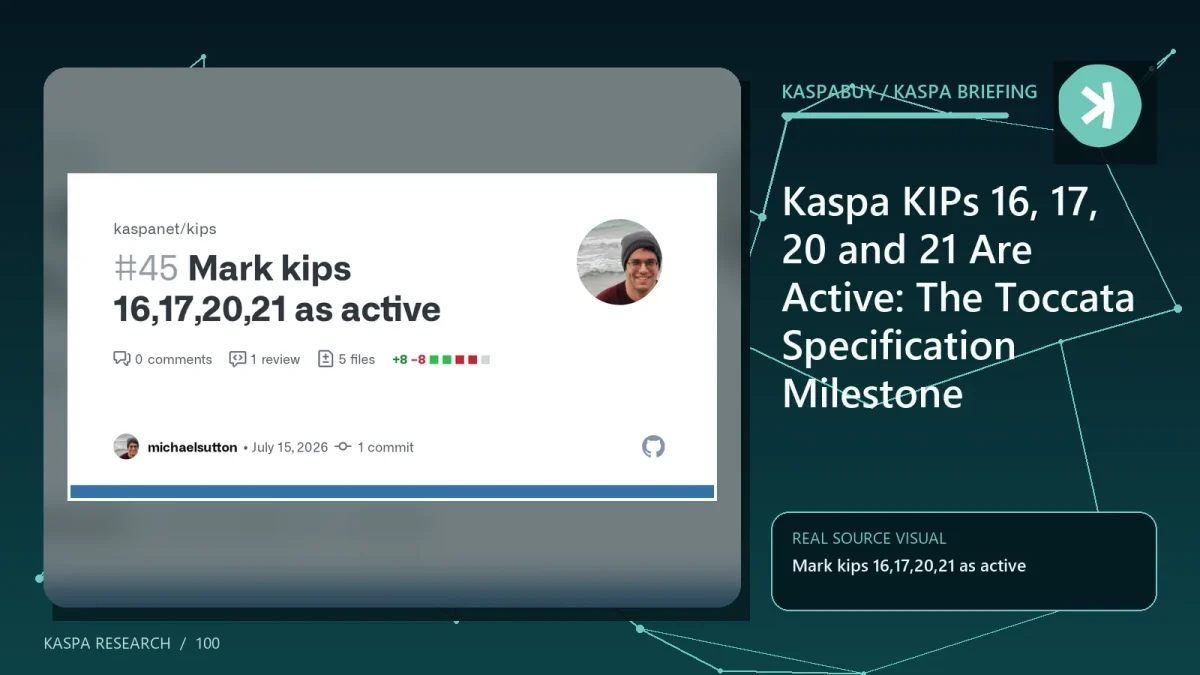
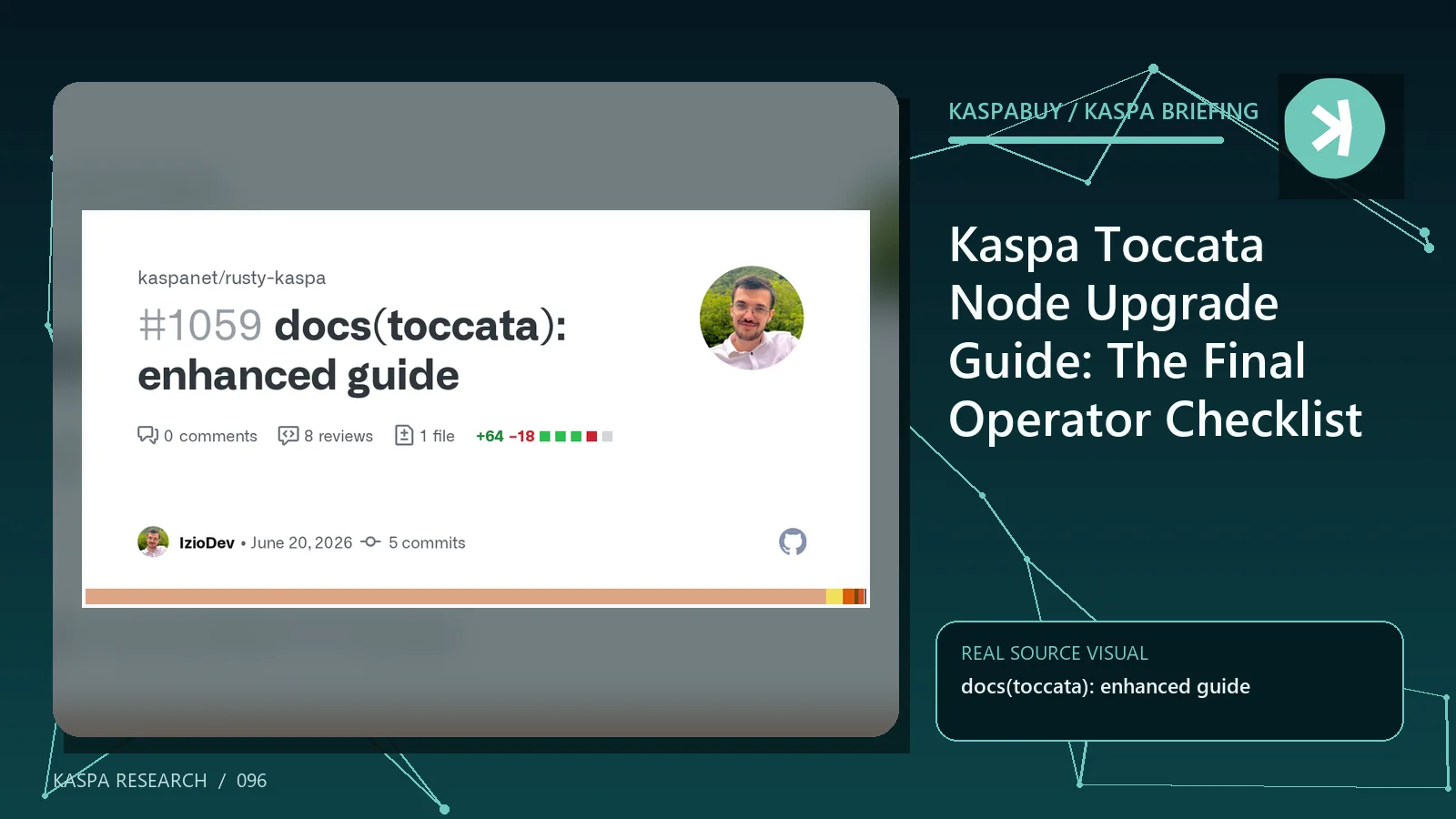
Rusty-kaspa PR #1059, merged June 21, rewrote the guide around operator personas. Its stated idea was to tell each reader what they need to notice instead of making everyone infer consequences from a general protocol summary. The five-commit documentation change added 64 lines, removed 18 and touched one file.
The patch updated the recommended binary from v2.0.0 to v2.0.1 or newer, pointed source builders to the stable branch, documented new gRPC fields, added a block-reward information RPC, and split required actions among network users, wallets, exchanges, miners, pools, explorers and indexers.
This role-based structure is important because Toccata affects more than consensus validation. Even when a node follows the upgraded chain, an integration can still lose covenant data, misprice a submitted transaction, reject version 1, or reconstruct a mined block without the fields in its template.
What should every Kaspa node operator verify?
First, identify every mainnet node under your control, including standby, reporting and wallet-facing instances. Confirm that each runs v2.0.1 or a later maintained release from the official repository. A mixed fleet can create confusing results if one service queries an upgraded node while another submits through an old one.
Second, verify normal synchronization, peer connectivity and RPC access after upgrade. Compare network identifiers and current virtual DAA score. Preserve your existing security controls: bind administrative RPC interfaces appropriately, restrict firewall exposure and keep keys separate from general node operations.
Third, monitor the activation boundary. The guide warns that failing to upgrade can split a node from the upgraded network. “The process is running” is therefore not sufficient evidence. Operators should confirm that their node remains synchronized with trusted independent references and that dependent services continue to advance.
Finally, keep the upgrade artifact and source provenance. The v2.0.1 GitHub release is signed and describes itself as both a drop-in update for v2.0.0 nodes and a Toccata upgrade path from pre-Toccata 1.x nodes. Use official checksums and release assets where provided, not binaries reposted through an unrelated channel.
What must wallets and exchanges test?
Wallet software using the RPC fee-estimation API requires no special fee formula change, according to the guide. Software with a fixed minimum-fee assumption must update to 100 sompi * max(compute grams, 2 * transaction bytes). The guide explicitly identifies this as node and mempool policy, not consensus: a zero-fee transaction can be consensus-valid while a node refuses to relay or accept it through RPC.
Manual transaction builders must recognize transaction version 1, input computeBudget, output covenant, and the renamed storageMass or storage_mass field. JSON maintains a deprecated mass alias for compatibility, but new integrations should emit the new name. If both JSON names appear, their values must agree.
An exchange readiness test should cover:
- deposit detection and confirmation updates;
- withdrawal construction, fee estimation, signing and submission;
- indexing and balance reconciliation after restart;
- version-1 parsing and database persistence;
- reorganization handling and duplicate-event protection;
- regenerated gRPC bindings where the exchange maintains its own client code.
Updated SDK choices named by the guide include rusty-kaspa v2.0.1 or newer and Go Kaspad v0.12.23. Teams should test the exact SDK and generated protobuf version they deploy, not assume compatibility from a similar staging component. This fits the broader rusty-kaspa v2.0.1 RPC and sync changes documented for infrastructure maintainers.
What must miners and pools preserve?
A miner using a pool should verify that the pool has upgraded. A solo or private operator should use an updated node with the provided Stratum Bridge or another Toccata-compatible mining stack. Custom pool software has the most detailed obligation: it must round-trip all post-Toccata block-template fields without dropping or overwriting them.
The guide specifically calls out block-header version, transaction version 1, RpcTransaction.storage_mass, RpcTransactionInput.computeBudget and RpcTransactionOutput.covenant. If a pool serializes template transactions into a custom job protocol, both the outbound job and inbound solved-block reconstruction need space for these values. After activation, stripping a required field can make the submitted block invalid.
Test the complete sequence on Testnet-10 where possible: GetBlockTemplate, work distribution, solved-share or block handling, block reconstruction and SubmitBlock. Pre-activation mainnet templates cannot meaningfully exercise every activated transaction path.
PR #1059 also documented GetBlockRewardInfo. Given a block hash, it can return the header, block color, confirmation count, merging-chain block hash and, for a blue block, reward amount. Pools should use it for post-merge reward attribution rather than rely on a locally guessed outcome under load.
What should explorers and indexers change?
Explorers, indexers and API services need schemas capable of storing version-1 inputs and outputs, compute budgets, covenant bindings, UTXO covenant IDs and storageMass. They should review GetSeqCommitLaneProof if their application exposes KIP-21 lane-proof data, and GetBlockRewardInfo if it reports block color or attributable rewards.
The critical test is a decode-store-read round trip. Fetch a representative post-activation transaction, store every new field, read it back through the public API and compare it with the node response. This catches silent truncation that a unit test focused only on successful deserialization can miss. The Toccata feature guide explains why these fields exist; the operator guide determines whether infrastructure preserves them.
What this checklist cannot guarantee
Passing this checklist does not prove that proprietary exchange, wallet or pool code is bug-free. It verifies named compatibility boundaries from the official guide. Each operator still needs deployment-specific monitoring, rollback planning and incident ownership.
The scheduled time was approximate because consensus activation is keyed to a DAA score, not a wall-clock alarm. Operators should use the configured score as the authoritative boundary and avoid delaying an upgrade based on a human-time estimate.
The guide also does not make third-party contracts safe. Supporting covenant and ZK fields means the infrastructure can transport them; it does not audit the application logic those fields represent.
Frequently asked questions
Is rusty-kaspa v2.0.0 sufficient?
The enhanced guide recommends v2.0.1 or newer. v2.0.1 incorporates additional RPC, wallet, synchronization and covenant-handling refinements while remaining a Toccata upgrade release.
Is the new minimum fee a consensus rule?
No. The guide labels it a standard transaction policy enforced by nodes and mempools. Consensus validity and relay acceptance are different questions.
Does a regular user need to run upgrade commands?
If the user does not operate a node, wallet service, exchange, pool, explorer or other Kaspa infrastructure, the guide says no operator action is required. Users should still obtain wallet updates from their wallet’s trusted distribution channel.
Source and verification note
This checklist is based on rusty-kaspa PR #1059, its public diff, the maintained Toccata hardfork node setup guide, and the official v2.0.1 release notes. Details are stated as of June 28, 2026, before the scheduled activation; operators should always follow newer official releases or advisories if the repository changes.