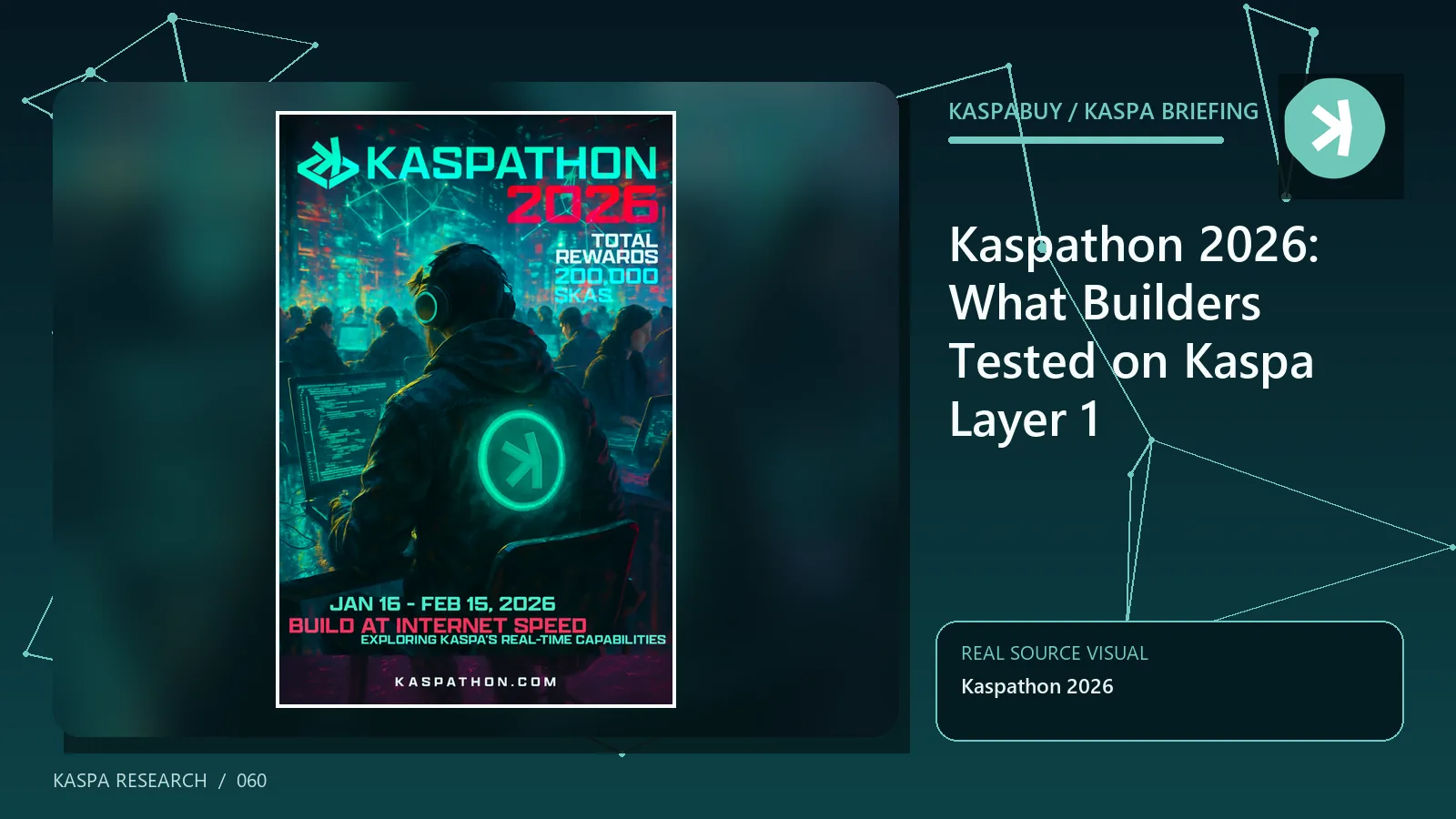
Kaspathon 2026 was a community-organized hackathon that asked builders to demonstrate meaningful Kaspa integration through working, open-source projects. By February 13, the event was approaching its February 15 deadline across general applications, payments and commerce, gaming, and real-time data. These were prototypes under evaluation, not proof that every entry was production-ready.
Key takeaways
- DoraHacks listed Kaspathon from January 16 through February 15, 2026, while KASmedia reported that it had entered its final submission phase.
- Organizers required meaningful Kaspa interaction, such as signing and broadcasting transactions, payment validation, on-chain attestations, or DAG-oriented high-frequency logic.
- The competition covered a main general track plus payments and commerce, gaming and interactive applications, and real-time data.
- Judges scored originality, real-world applicability, user experience, technical implementation, and documentation rather than throughput claims alone.
- A hackathon demo is evidence of developer experimentation; it is not an audit, service-level guarantee, adoption metric, or KAS price signal.
What was Kaspathon 2026?
The February 13 KASmedia report described Kaspathon as the first global, community-led Kaspa hackathon and said it was entering its final phase before the February 15 submission deadline. The DoraHacks February newsletter independently listed Kaspathon: Build at Internet Speed as running from January 16 to February 15.
KASmedia reported a 200,000 KAS prize pool and four broad tracks: general high-performance applications, payments and commerce, gaming and interactive experiences, and real-time data infrastructure such as IoT or live-data anchoring. Earlier KASmedia coverage said 205 developers were participating at kickoff, a reported registration snapshot rather than a verified count of completed submissions.
Because this article is dated before the deadline, it does not assign winners or treat unfinished entries as completed products.
What counted as meaningful Kaspa integration?
The official Kaspathon terms required more than placing a Kaspa logo on a conventional web application. Qualifying examples included transaction signing and broadcasting, payment validation or attestation, on-chain proof of an action or content, and DAG-based high-frequency logic.
Projects also had to be open source under an OSI-approved license, disclose pre-existing code, and demonstrate significant new work completed during the hackathon. AI coding tools were allowed, but entrants had to document their use and demonstrate understanding beyond simple prompting.
Those rules make “built on Kaspa” more falsifiable. Reviewers could inspect source code, commit history, network interactions, documentation, and demos. They still did not guarantee that every entrant met the standard; determining that was part of judging.
What did payments and commerce teams test?
Payments teams could test address handling, transaction construction, broadcasting, confirmation, validation, refunds, and merchant interfaces. A real checkout must also handle network errors, incorrect amounts, duplicate callbacks, price conversion, and wallet compatibility. One hackathon flow cannot establish uptime, accounting correctness, compliance, or secure key management.
For a broader community-facing route into the technology, Kaspa community merch as education explains how physical products can start useful conversations without pretending merchandise is protocol adoption.
What did gaming and interactive projects test?
Interactive applications need frequent updates, clear pending states, deterministic rules, and recovery from rejection or reordering. Builders explored whether Kaspa’s cadence could support responsive workflows, but reviewers still needed to identify Layer-1 versus server state, conflict handling, and key custody. Fast settlement cannot correct exploitable game rules, weak randomness, or unsafe wallet permissions.
What did real-time data teams test?
Real-time data projects could anchor hashes or proofs so observers later verify that data existed in a particular form. Anchoring does not prove a sensor was truthful: device identity, signatures, clocks, storage, privacy, and oracle design remain separate. KASmedia framed applications as a real-world stress test but published no controlled benchmark across all entries and failure modes.
How were projects judged?
Rules weighted originality at 25%; real-world applicability, user experience, and technical implementation at 20% each; and documentation at 15%. Up to ten judges could include core developers, ecosystem builders, community members, foundation representatives, and product experts. The rubric rewarded reproducibility and honest architecture, not only a flashy demo. The 200,000 KAS pool measured incentives, not long-term adoption.
Did Kaspathon prove Kaspa was an application platform?
Working submissions can expose SDK gaps, wallet friction, indexing needs, and network behavior. KASmedia did not prove every component ran on mainnet or Layer 1; meaningful Kaspa interaction can coexist with off-chain interfaces, storage, or computation. Production readiness still requires maintenance, threat modeling, review, monitoring, and users. Evaluate later evidence separately, as in Kaspa adoption signals after Unchained Summit Vietnam.
What were the price implications?
A hackathon can generate open-source experiments but cannot guarantee businesses, users, or fee demand. Neither KASmedia nor the rules provide a KAS price model, so no price prediction follows.
Frequently asked questions
When did Kaspathon 2026 run?
DoraHacks listed January 16 through February 15, 2026. KASmedia published its final-phase report on February 13.
Did projects have to be open source?
Yes. The published terms required an OSI-approved open-source license and disclosure of pre-existing work.
Did every project run fully on Kaspa Layer 1?
The rules required meaningful Kaspa interaction, but that does not prove every component of every submission was on-chain. Architecture must be verified project by project.
Were the entries audited production applications?
No such blanket claim is supported. Hackathon judging evaluates submissions; production security, reliability, and compliance require additional work.
Source and verification note
This article uses the February 13 KASmedia report as the assigned news source and verifies its dates through DoraHacks’ February newsletter. Integration rules, judging weights, licensing, and prize allocation come from the official Kaspathon terms. These sources establish event structure and organizer claims; they do not independently benchmark every entry, prove mainnet deployment, certify security, demonstrate adoption, or support a KAS price forecast.