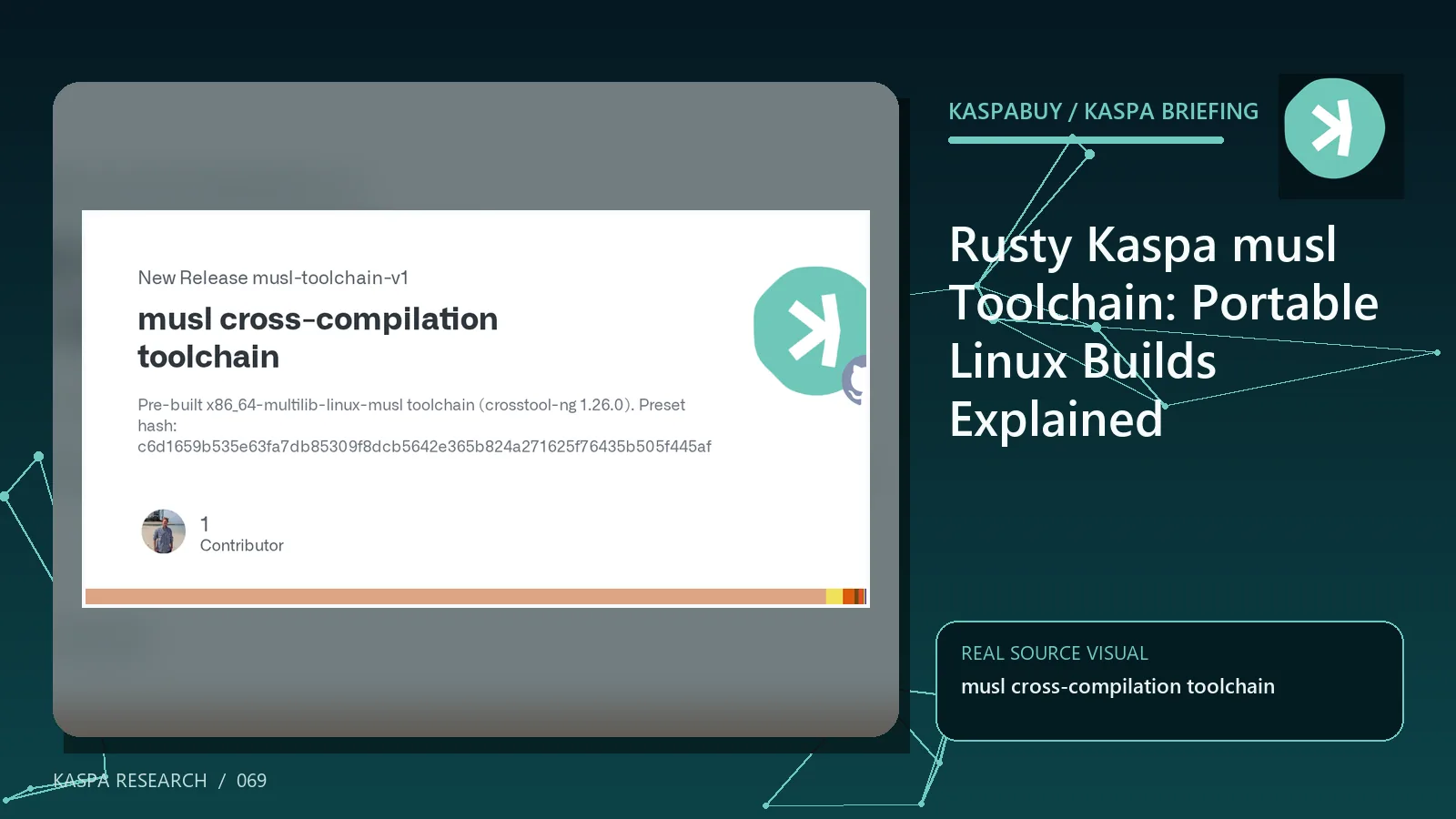
The Rusty Kaspa musl toolchain was a March 2026 release asset for building statically linked x86-64 Linux binaries. It packaged a crosstool-ng 1.26.0 toolchain and supported the project’s release workflow for kaspad, wallet, Rothschild, and Stratum Bridge artifacts. It improved deployment portability, not protocol behavior or universal Linux compatibility.
Key takeaways
- The
musl-toolchain-v1release provided a pre-builtx86_64-multilib-linux-muslcross-compilation toolchain. - Rusty Kaspa’s workflow targeted
x86_64-unknown-linux-musland requested static linking for Linux release binaries. - The build script configured C, C++, linker, archiver, OpenSSL, Cargo, and Rust target variables for one consistent environment.
- A preset hash controlled cache invalidation, but it was not a checksum for downloaded release assets.
- This tooling did not change Kaspa consensus, node behavior, transaction fees, or the KAS price outlook.
What exactly was the Rusty Kaspa musl toolchain release?
The official musl-toolchain-v1 release was published on March 27, 2026. Its note identifies a pre-built x86_64-multilib-linux-musl toolchain generated with crosstool-ng 1.26.0 and records the hash of the preset used to configure it.
The explicit release assets included x-tools.tar.zst, which packaged the cross-toolchain, and a WASM SDK archive generated by the normal release event. This tag was not presented as a Rusty Kaspa node version. Installing it did not upgrade a running node or alter network rules.
That distinction matters because the adjacent Rusty Kaspa v1.1.0 release guide covers application binaries and node behavior; musl-toolchain-v1 documented build infrastructure.
How did the official build script create the toolchain?
The tag’s musl build script selected the x86_64-multilib-linux-musl preset, built crosstool-ng 1.26.0 when a cached toolchain was absent or stale, and installed the output under ~/x-tools.
It then exported the cross C compiler, C++ compiler, linker, archiver, and ranlib paths. Cargo-specific variables pointed the x86_64-unknown-linux-musl target at those tools. The script enabled static OpenSSL, added -static through RUSTFLAGS, installed the Rust target, and fetched target dependencies.
This coordination is important because Rusty Kaspa includes native dependencies. Selecting a Rust target alone is not enough when C or C++ libraries are compiled and linked as part of the workspace.
How did Rusty Kaspa use it for portable Linux builds?
The tag’s official deployment workflow stated that musl was used to make Linux binaries statically linked and portable. On an Ubuntu runner, it sourced the toolchain script and built kaspad, rothschild, kaspa-wallet, and stratum-bridge for x86_64-unknown-linux-musl.
The workflow then collected those binaries into the Linux AMD64 release archive. The Stratum Bridge build appended a linker option to handle a symbol collision specific to that binary. This is evidence of an automated packaging path, not proof that every arbitrary host or modified dependency will compile cleanly.
Related Kaspa CheckSigFromStack opcode analysis covers script-engine development rather than packaging; build portability and consensus semantics should be evaluated separately.
Why can musl improve Linux portability?
Linux distributions can ship different versions of the GNU C library and related shared libraries. A dynamically linked binary may fail when a required symbol or library version is absent on the target host. Static linking with musl can bundle more runtime dependencies into the executable, reducing dependence on a distribution’s installed C library.
“Portable” remains bounded. This toolchain targeted x86-64 Linux, not ARM, Windows, macOS, or every processor feature level. A static binary still depends on a compatible Linux kernel, filesystem permissions, networking, CPU behavior, and the application’s own data format. It can also require special handling for name resolution, certificates, or other runtime resources.
Operators should test the actual archive on the oldest supported environment instead of assuming that static linking makes it universal.
What did the preset hash prove?
The build script calculated SHA-256 over musl-toolchain/preset.sh and compared it with a stored value. When the preset changed, the cache was rebuilt. The release note published that preset hash so maintainers could identify the configuration behind the pre-built toolchain.
It was not the SHA-256 checksum of x-tools.tar.zst or any node binary. Users should not compare an asset download with the preset hash and interpret a mismatch as corruption. Asset authenticity still depends on using the official repository, checking the release and signed tag information, and following any separately published checksums or reproducible-build procedure.
Who benefited from this release engineering work?
Maintainers gained faster repeat release builds by caching an expensive native toolchain. Contributors gained a documented path for reproducing the Linux target. Node operators benefited indirectly when official Linux packages depended less on host shared libraries.
The toolchain did not eliminate supply-chain risk. The workflow fetched packages, crosstool-ng sources, Rust components, and project dependencies. Pinned versions, hashes, signed sources, restricted CI permissions, and repeat builds remain important controls. Teams building their own binaries should review the scripts rather than executing downloaded build environments blindly.
Did the toolchain affect roadmap, fees, or price?
Reliable packaging can reduce operational friction, but it does not increase block throughput or activate features. The release supplied no benchmark of node adoption, uptime, synchronization speed, or network decentralization. It also supplied no KAS valuation model. Build tooling is an engineering input, not a price prediction.
Frequently asked questions
Was musl-toolchain-v1 a Rusty Kaspa node release?
No. It was a toolchain tag and build asset. Operators looking for node software needed the appropriate numbered Rusty Kaspa release.
Did it support ARM Linux?
The documented preset and Rust target were x86-64. The cited release did not establish an ARM toolchain.
Does static linking guarantee a binary runs on every Linux system?
No. It reduces shared-library dependencies, but kernel, architecture, permissions, runtime resources, and application requirements still apply.
Was the published preset hash an asset checksum?
No. The script used it to identify the preset configuration and invalidate its cache. It should not be substituted for a release-asset checksum.
Source and verification note
This article is based on the official musl-toolchain-v1 release, the tag’s build script, and its deployment workflow. These sources establish the target, crosstool-ng version, static-link settings, cache behavior, and packaged binary list. They do not establish universal portability, reproducible byte identity, a security audit, node adoption, protocol change, or a KAS price effect.