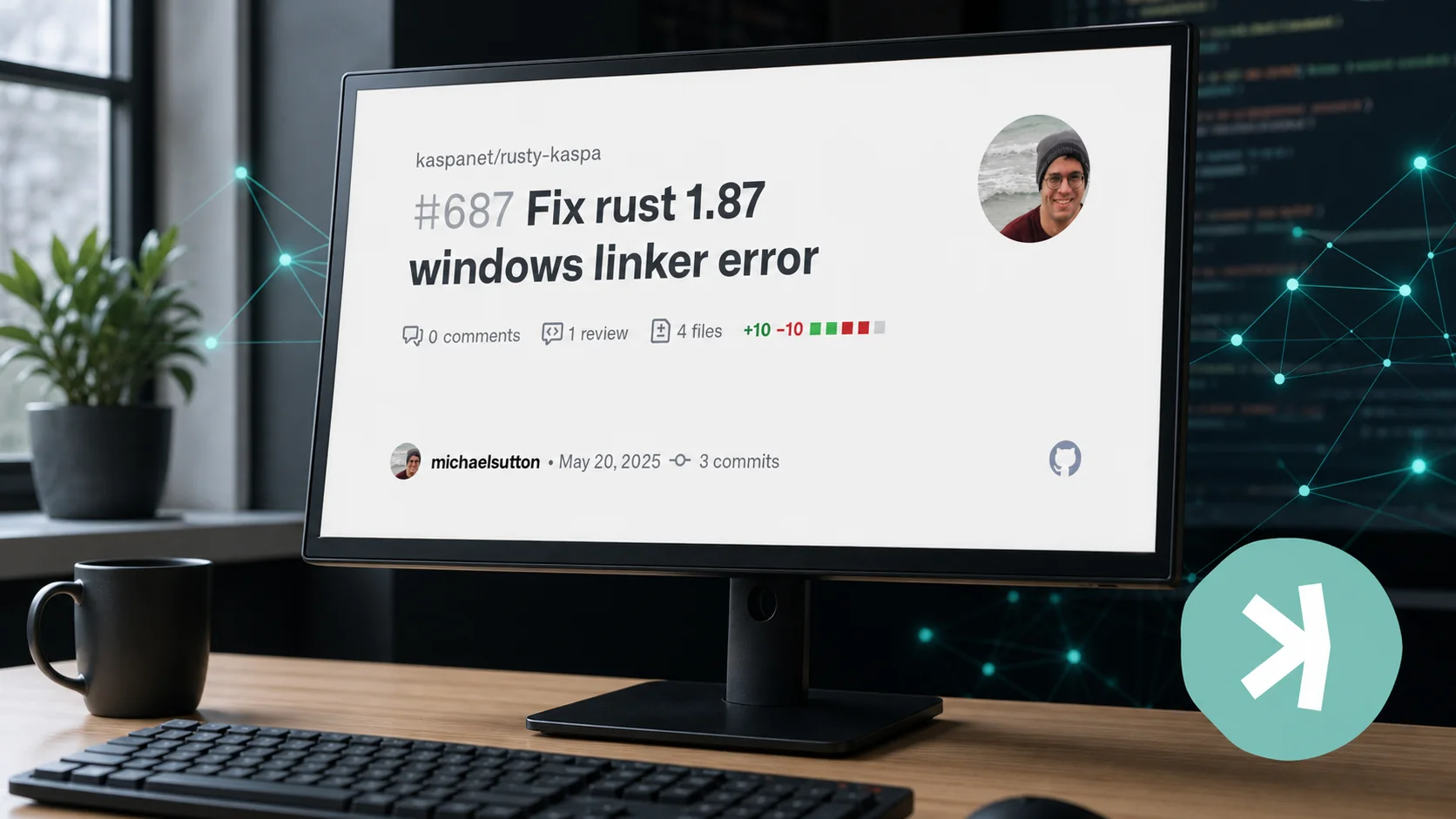
Rusty Kaspa on Windows encountered a linker error after Rust 1.87 stopped linking the Windows advapi32 library through the standard library by default. Merged pull request #687 temporarily pinned the mimalloc Rust binding to a commit that explicitly restored that link, allowing affected builds to complete while awaiting a normal crate release.
Key takeaways
- The failure came from a Rust 1.87 Windows compatibility change, not a Kaspa consensus defect.
- Rusty Kaspa’s allocator dependency relied on linkage that was no longer implicit.
- PR #687 pinned
mimalloc_rustto a reviewed commit containing the explicitadvapi32link. - The patch changed four files and recorded that the workaround should be removed after a suitable release.
- Builders should reproduce the official dependency lockfile instead of improvising a permanent local patch.
What caused the Rusty Kaspa Windows linker error?
Rust 1.87 changed how its standard library behaved on Windows: it no longer linked advapi32 by default. Software that indirectly depended on that implicit linkage could compile successfully with an earlier toolchain and then fail at the final linking stage after an upgrade.
Rusty Kaspa uses mimalloc as an allocator on supported configurations. At the time of the issue, the latest published binding did not yet include the required explicit Windows link, although the upstream repository contained a corrective commit. The merged Rusty Kaspa pull request explains this dependency chain and links it to the Rust 1.87 compatibility notes.
That makes the scope clear. Consensus logic and on-chain data were not being changed; the build system needed to declare an operating-system library that could no longer be assumed.
How did pull request #687 fix it?
The patch changed the allocator dependency from a crates.io version to a specific mimalloc_rust Git commit. That commit included an explicit advapi32 link in its build script. Pinning by revision made the dependency deterministic: every builder using the lockfile would fetch the same reviewed source rather than whatever happened to be at the head of a branch.
The pull request recorded 10 additions and 10 deletions across four files. Cargo.toml and Cargo.lock carried the allocator change. A WASM manifest received a formatting-only newline adjustment, and a concurrency test’s timeout increased from 100 to 500 milliseconds to reduce failures on slow continuous-integration workers.
The maintainers also added TODO comments to move back to a released version newer than 0.1.46 when available. That is an important sign that the Git pin was a controlled compatibility bridge, not the preferred long-term dependency policy.
What is advapi32 and why did linking matter?
advapi32.dll is a standard Windows system library exposing parts of the platform API. Native dependencies can require symbols from it even when the application developer never calls those functions directly. Rust crates with C or C++ components often use build scripts to communicate such native link requirements to Cargo.
Compiling and linking are separate stages. Source files can compile into object code successfully, yet the linker can still fail when it cannot resolve a referenced symbol. This is why the error surfaced late in the build and why adding or restoring the correct native-library declaration solved it.
What should Windows builders do?
First, build a supported Rusty Kaspa revision and keep its Cargo.lock intact. The lockfile is part of reproducibility for an application-sized Rust workspace. Running an arbitrary dependency update can reintroduce a compatibility boundary that the chosen source revision was not tested against.
Second, use the documented Rust toolchain and Microsoft build tools for the target. Capture the complete linker output, rustc --version, Cargo version, Windows version, target triple, and source commit when reporting a failure. “It does not compile” is much harder to diagnose than a minimal environment record.
Third, do not download unknown DLL files from the web to silence a linker message. advapi32 is supplied by Windows; this issue was about build metadata, not a missing third-party binary.
Why small build fixes matter to a network project
A decentralized network benefits when developers and operators can reproduce software across common platforms. A ten-line dependency fix can widen or preserve the contributor path even though it does not change protocol behavior. Windows compatibility is especially relevant for wallet tooling, local test environments, and new contributors who are not running a Linux build host.
The fix arrived shortly after the network’s major upgrade described in Kaspa after Crescendo. Together, the two changes illustrate different layers of maintenance: consensus upgrades shape network rules, while build-system fixes keep the implementation accessible.
How should maintainers handle temporary Git dependencies?
Pin an immutable commit, document why it is needed, inspect the relevant upstream changes, and create a clear exit condition. Continuous integration should cover the affected platform. Once a released crate contains the fix, return to the package registry after normal review and testing.
This approach reduces supply-chain ambiguity. A branch name can move; a commit hash does not. The pull request also stated that intervening upstream changes had been inspected and were confined to build-script work, making the decision auditable.
Frequently asked questions
Did this error stop the Kaspa network?
No. It affected certain Windows source builds using Rust 1.87. It was not a mainnet outage or a consensus failure.
Should users manually add advapi32.dll to the Rusty Kaspa folder?
No. The merged fix corrected dependency linkage. Copying DLLs from untrusted sources is unsafe and does not address the build metadata correctly.
Why not stay on an older Rust compiler forever?
Pinning an older compiler can be a short diagnostic step, but maintained projects need a reviewed path to newer toolchains for security fixes, platform support, and ecosystem compatibility.
Source and verification note
The primary source is kaspanet’s merged rusty-kaspa pull request #687, merged May 20, 2025. The cause can be cross-checked in the official Rust 1.87 release compatibility notes. File counts and dependency behavior are drawn from the public diff, not inferred from market commentary.