
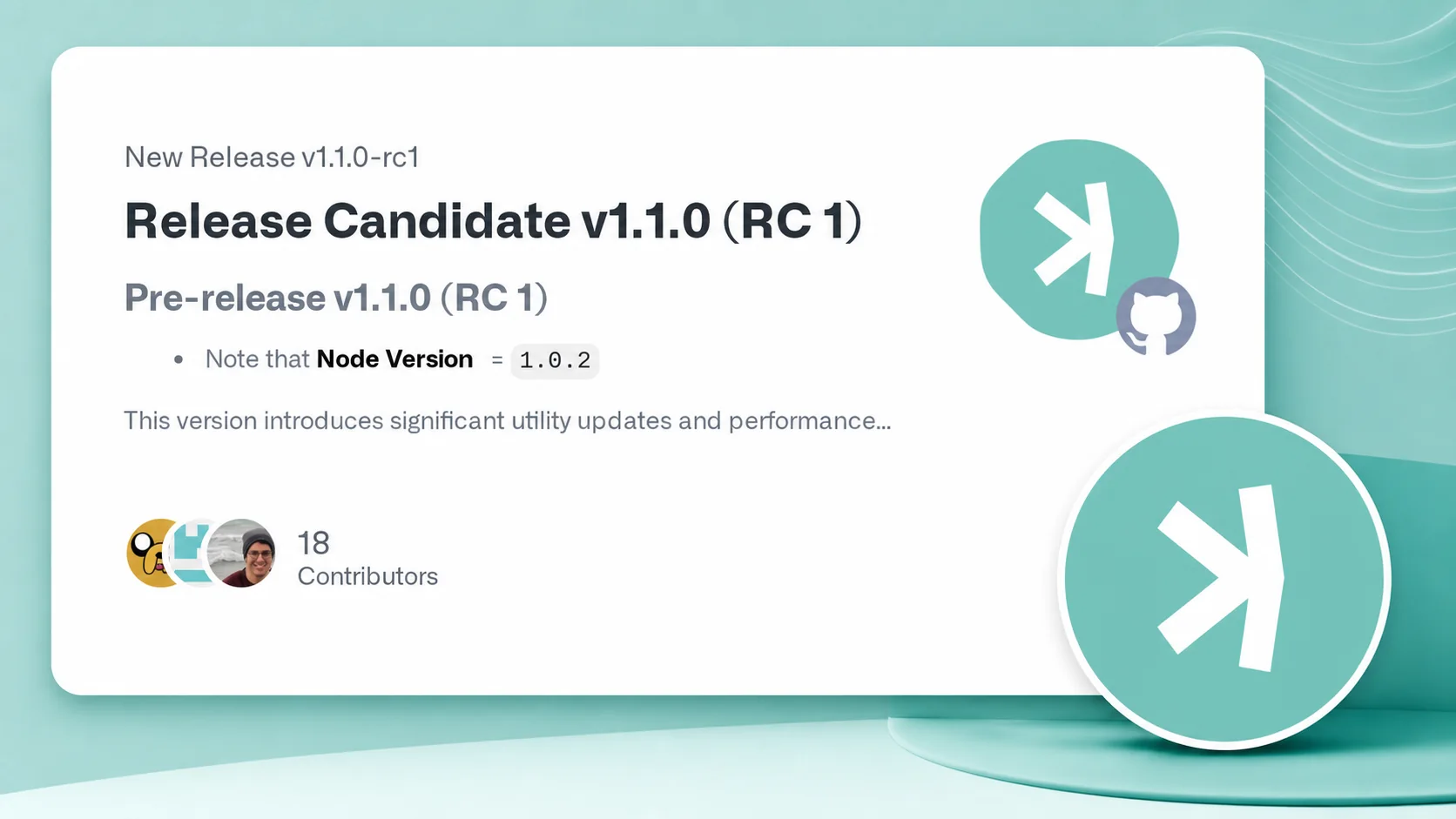
Rusty Kaspa v1.1.0 RC1 was a pre-release package published on January 15, 2026, not a final upgrade signal. It bundled VSPC API v2, initial block download and storage work, RocksDB presets for HDD archive nodes, a beta Stratum bridge, and broader performance changes for operators and integrators to test before stable release.
Key takeaways
- GitHub labels v1.1.0 RC1 as a pre-release and says its detailed walkthrough would arrive with the final release.
- The headline additions were VSPC API v2, IBD enhancements, RocksDB presets, the in-house Stratum bridge in beta, and storage and pruning performance work.
- The tag was
v1.1.0-rc1, while the release note explicitly reported node version1.0.2; operators needed to record both identifiers when testing. - The changelog covered more than 50 merged pull requests, so the candidate was an integration checkpoint rather than one isolated feature.
- A release candidate improves confidence through testing; it does not prove production readiness, miner adoption, uptime gains, or a future KAS price response.
What did Rusty Kaspa v1.1.0 RC1 contain?
The official Rusty Kaspa v1.1.0 RC1 release names five feature groups. VSPC API v2 offered a simplified and unified flow for common integration use cases. IBD changes targeted initial synchronization. A RocksDB preset system added native configurations for regular and HDD-backed archive nodes. The project also packaged its own Stratum bridge as beta software and highlighted lower storage use plus faster header and pruning processing.
The full changelog is broader than that summary. It includes WASM and PSKT changes, Docker files for all binaries, environment-variable configuration, Windows Keccak assembly support, peer-protocol cleanup, pruning-proof work, compressed headers, consensus-parameter overrides, RPC aggregation, and multiple Crescendo cleanup patches.
That breadth is precisely why the RC label matters: maintainers were asking users to exercise a combined build whose components could interact in ways that individual pull-request tests would not reveal.
Why was VSPC API v2 important for integrators?
The release describes VSPC API v2 as a simplified, unified flow designed to cover most integration cases. In practical terms, an API consolidation can reduce the number of separate calls and local assumptions an indexer, explorer, wallet service, or monitoring system must maintain when consuming selected-chain information.
The release note does not publish a complete migration guide, schema guarantee, or performance benchmark for VSPC v2. Integrators therefore needed to compare their actual request and response models against the candidate, run historical and live-state tests, and retain rollback capability. A versioned API name signals that existing consumers should not assume wire-level compatibility without checking.
How did the node and storage work fit together?
Initial block download is the process by which a new or returning node obtains and validates enough chain and BlockDAG state to join the current network view. The RC combined several relevant changes: body-download optimization, pruning movement handling, faster header and pruning processing, guided proof-context work, and compressed P2P headers.
The RocksDB preset system addressed a different layer. Storage configuration that suits SSD hardware may perform poorly on an HDD archive node. Native presets and separate write-ahead-log directory support give operators a supported starting point instead of relying entirely on undocumented tuning. Presets are not universal guarantees, however; disk model, memory, filesystem, database age, compaction, and workload still affect results.
For a deeper look at the related design, see Kaspa Pruning-Proof Optimization: Better Sync Without More Stored History.
What did the beta Stratum bridge change?
The candidate included an in-house Rusty Kaspa Stratum bridge in beta. A Stratum bridge translates the work-distribution protocol used by mining software into interaction with a Kaspa node. Keeping that component near the reference-node codebase can make version alignment, deployment, and issue reporting more coherent.
Beta remains the operative word. Pool operators should test job delivery, share handling, reconnect behavior, node failover, logging, authentication boundaries, and resource use before replacing a working production path. The companion guide, Kaspa Stratum Bridge Binary: Connecting Mining Software to Rusty Kaspa, explains the integration boundary in more detail.
How should operators have tested RC1?
Use a staging node or a non-critical replica first. Record the release tag, commit, downloaded asset checksum, node-reported version, command line, database preset, hardware, and network. That record is especially important here because the release page says the tag is v1.1.0-rc1 but the node version is 1.0.2.
Measure a clean sync and a restart from existing data. Verify peer count, virtual state, RPC responses, UTXO index behavior if enabled, disk growth, database compaction, and application queries. Archive-node operators should test the correct preset on representative storage. Mining operators should isolate beta bridge tests from payout-critical infrastructure.
Finally, read later candidate notes before promoting the build. RC2 subsequently documented a fresh-node UTXO-index issue in RC1, illustrating why release candidates need staged observation rather than automatic production deployment.
What were the limits of the release evidence?
The release uses phrases such as “significant reduction” and “accelerated” but supplies no standardized hardware, dataset, test duration, or confidence interval. Those are project release claims, not independent benchmarks. The changelog establishes that code was merged; it does not establish that every workload benefits equally.
Nor does RC1 document a consensus activation, issuance change, or guaranteed network-wide adoption event. Better node efficiency can improve the cost of participation and developer experience, but translating engineering work into adoption or market value requires separate evidence.
Frequently asked questions
Was Rusty Kaspa v1.1.0 RC1 a stable release?
No. GitHub marks it as a pre-release, and the maintainers said more detailed explanations would be included in the final release notes.
Did every operator need the HDD preset?
No. The release specifically highlights native support for HDD archive nodes and preset configurations. Operators should choose a preset for their hardware and node role, then validate it with measurements.
Did RC1 activate new consensus rules?
The release note presents utility and performance updates. It does not announce a hardfork activation or claim that the candidate alone changed mainnet consensus rules.
Did RC1 guarantee a KAS price increase?
No. Software quality is one fundamental input, while price also depends on liquidity, demand, macro conditions, access, expectations, and risk. A pre-release cannot support a deterministic forecast.
Source and verification note
This article is based on the official kaspanet/rusty-kaspa v1.1.0 RC1 release, published January 15, 2026. The source identifies the build as a pre-release, lists node version 1.0.2, names the five feature groups, and links each merged change. Performance language is attributed to the project because the release does not provide a reproducible benchmark protocol.